Explainer
What Is a Cashew Apple?
The fruit-like part of the cashew tree is a swollen flower stalk. It is edible, astringent and very perishable, which is why most of the world’s cashew apples never leave the orchard.
Quick answer
A cashew apple is the swollen, juicy stalk that the cashew nut hangs from. Botanically it is a false fruit: the true fruit is the kidney-shaped nut below it, which forms first. The apple is edible but bruises easily and keeps about a day once picked, so it is eaten, juiced or distilled near the trees, as with feni in Goa, and seldom travels far. In Vietnam, cashew apples are generally discarded after the nut harvest.
A cashew apple is the fleshy, fruit-like part of the cashew tree, Anacardium occidentale: a swollen flower stalk with the cashew nut hanging from its lower end.1,2 It looks like the fruit, but botanically it is a false fruit; the true fruit is the kidney-shaped nut below it.3,4 So when people ask what fruit cashews come from, the botanical answer is the nut that hangs below the apple, not the apple itself. How the tree grows and where the nuts go is covered in where cashews come from; this page is about the apple.
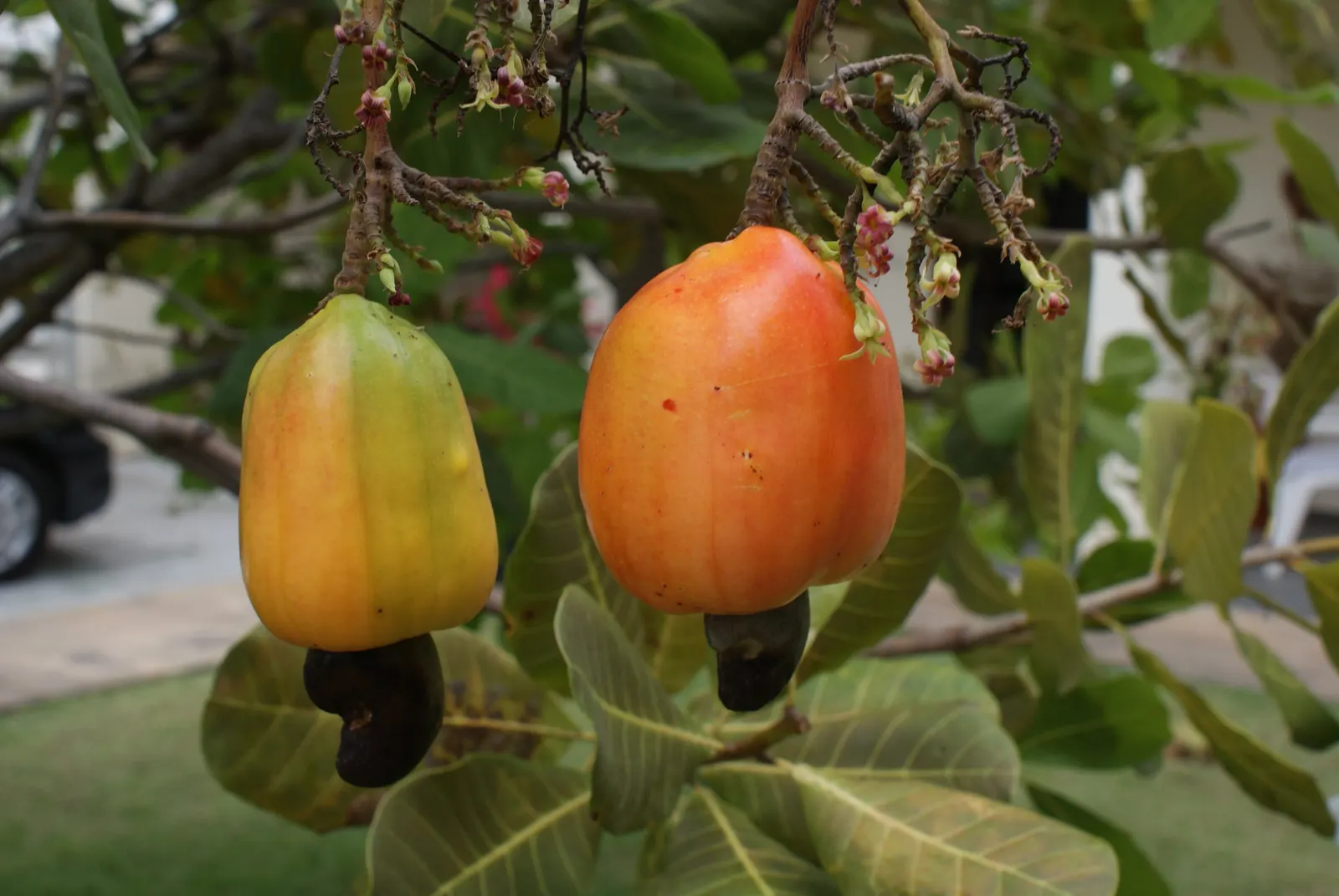

A false fruit with the nut on the outside
Cashew applequả điều
The odd shape comes from the order of growth. The nut forms first, at the end of the stem; only then does the stem swell into the apple, leaving the nut attached on the outside.5 Julia Morton’s Fruits of Warm Climates adds that the stalk fills out when the nut is full-grown but not yet ripe.6
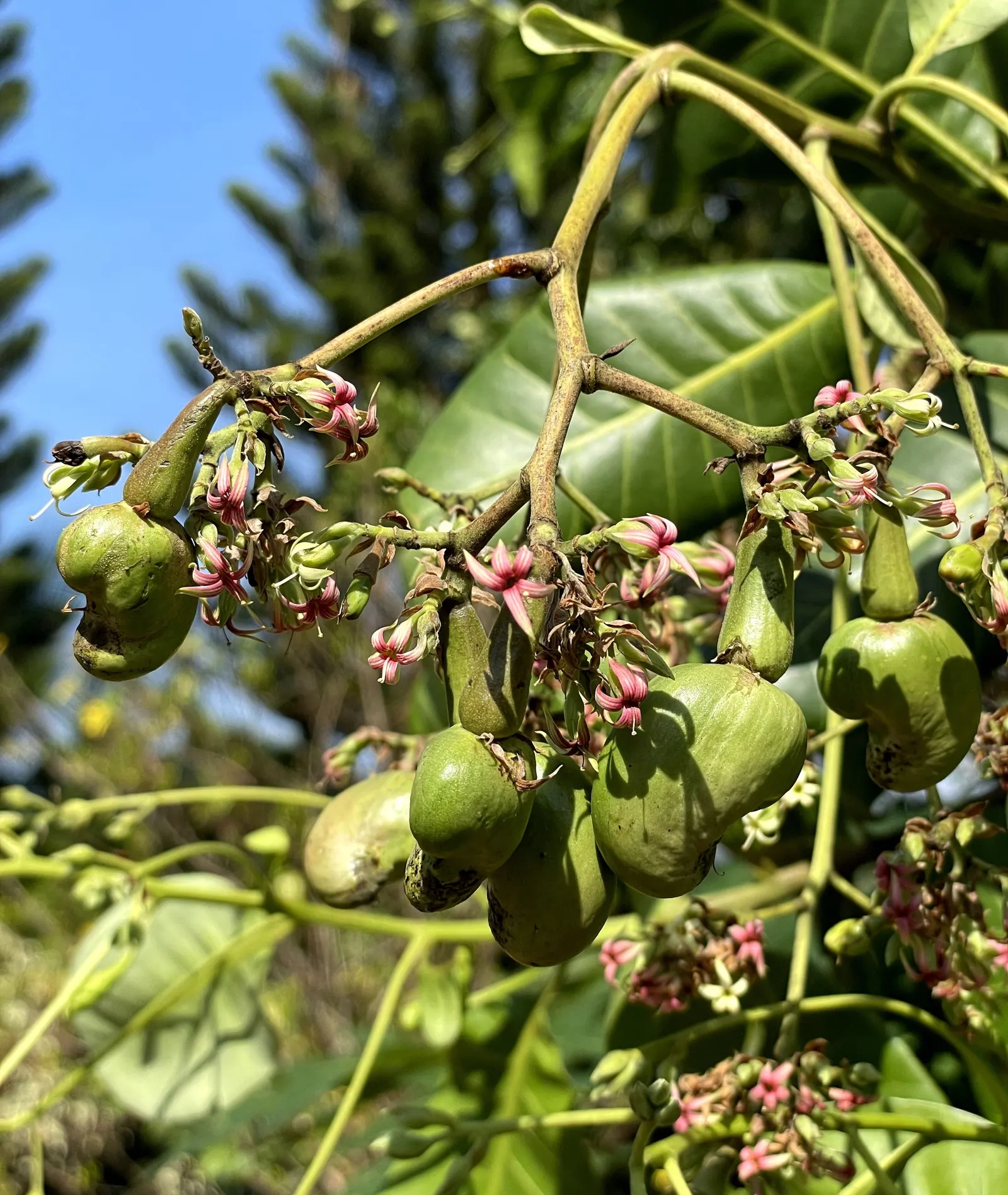

A ripe apple is roughly 5 to 11 cm (2 to 4½ in) long, with waxy yellow, red or red-and-yellow skin.6 What is inside a cashew apple is flesh, not a seed: Morton describes spongy, fibrous, very juicy yellow pulp.6 The seed is elsewhere, in the nut, whose shell, testa and kernel make up the true fruit.3 Each apple carries a single nut, and each nut holds a single kernel.7
By weight, the apple is most of the crop. An FAO manual puts the yield of cashew apples at eight to ten times the weight of the raw nuts.5
Why you rarely see cashew apples in shops
The short answer is shelf life. FAO’s manual says the cashew apple keeps only about 24 hours after picking and should be processed within two to three hours.5 The University of Florida notes that fruit which falls from the tree spoils within a day or two.8 Morton reports that yeasts and fungi cause spoilage after the first day at room temperature, though Indian food technologists kept apples in good condition for about 5 weeks at 0–1.7 °C.6
The fruit is also fragile. When stacked in layers, apples may burst and lose their juice under the weight above them, which makes moving large quantities difficult.5 Nuts travel; apples bruise easily and have a very limited shelf life, so cashew nuts are traded far more widely than the apples.7 FAO describes the apple as a product generally processed and consumed locally, and says its perishability and the distance to processing plants have held back its use.5
Timing works against the apple too. It ripens before the nut, which makes it hard to use the whole fruit commercially: nuts detached from green fruit are not of marketable quality.5 For nut growers, the usual practice is to let apple and nut fall together and collect them from the ground.6,5
How cashew apples are used
Where cashews grow, the apple is food. FAO lists it eaten fresh from the tree, squeezed for juice, dried and preserved; the juice is fermented into cashew wine, popular in West Africa, and in parts of India it is distilled into a liquor called feni.5
| Use | Where the sources place it | Source |
|---|---|---|
| Eaten fresh, juiced, dried, preserved | Cashew-producing countries generally | FAO (2001)5 |
| Cashew wine | West Africa, where FAO calls it very popular | FAO (2001)5 |
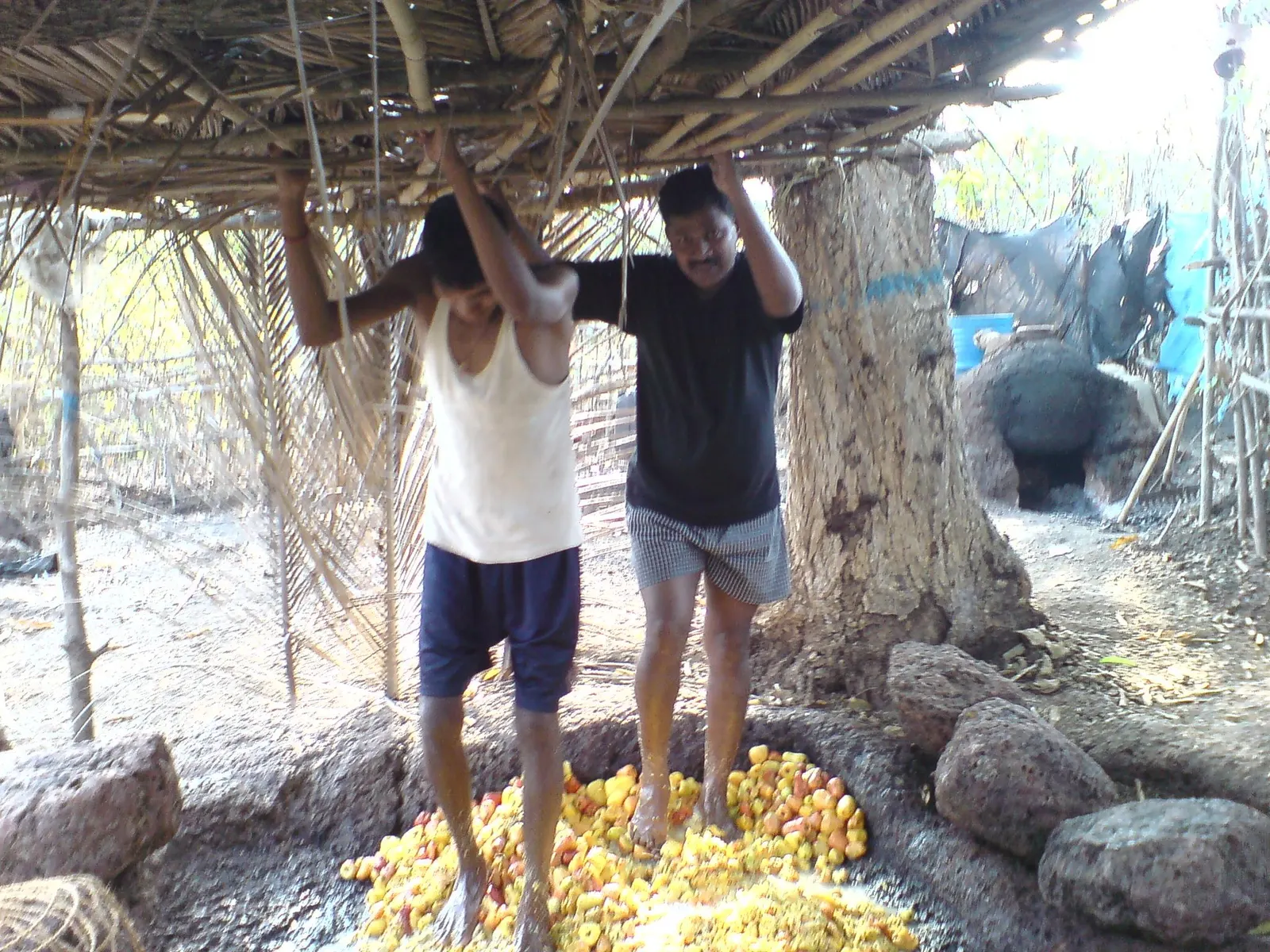
| Feni, a distilled spirit | Goa, India; the apples are still trodden by foot to extract the juice | Morton (1987)6 |
| Jams, soft and alcoholic drinks | Brazil, where fruit vendors display great heaps of apples | FAO (2001), Morton (1987)5,6 |
| Wines and distilled liquors | Brazil, Guatemala, West Africa, India, Sri Lanka and the Philippines, among others | UF/IFAS8 |
Feni is the one cashew apple product here with a protected name. India’s Geographical Indications Registry lists “Feni” as a registered geographical indication for Goa, filed on 19 December 2007 by the Goa Cashew Feni Distillers & Bottlers Association in class 33, the class for alcoholic beverages. Its certificate, No. 105, is dated 5 March 2009, and the registration is valid until 18 December 2027.9

Most apples, though, are not used at all. In 2001 FAO estimated that only about 6% of cashew apples were exploited, because the grower has a guaranteed market only for the nut.5 Morton describes the practice on commercial nut plantations: twist off the nut and leave the apple on the ground for cattle or pigs to graze later.6 The reverse also exists. The University of Florida notes areas of the Caribbean, South and Central America and East Africa where cashew trees are still grown solely for local apple consumption.8
Why the cashew apple is astringent
Sources describe the apple as pulpy and juicy, with “a pleasant but strong astringent flavour”,5 and its pulp as astringent and acid to subacid.6 Ripeness changes the balance: FAO notes that the riper the apple, the sweeter it tastes, and the University of Florida says apples become sweeter if left to ripen on the tree.5,8
The astringency comes from tannins. A 2019 Vietnamese study gives the tannin content of pressed cashew apple juice as 0.2–0.6%, enough to make it markedly astringent.10 FAO adds that the astringent, acrid taste is believed to originate in the waxy layer of the skin.5
Processing is built around removing it. The methods FAO’s manual recommends are steaming the fruit for five minutes and then washing it in cold water, boiling the fruit in salt water for five minutes, or adding a gelatin solution to the pressed juice.5 The University of Florida describes the same gelatin step: the tannins bind to the gelatin and settle out, and are filtered off.8 The Vietnamese researchers removed tannins from their juice with gelatin and the enzyme tannase before fermenting it.10
Cashew apples in Vietnam
In Vietnam the apple is treated as a by-product of the nut. According to a 2019 paper in the Can Tho University Journal of Science, cashew apples are found mainly in the South Central Coast, the Central Highlands and the Southeast, and are thrown away after the nut harvest.10 The same paper reports that 8–10 tonnes of apples come with about 1 tonne of raw nuts, and cites an estimate, from a 2014 study by Tran Nhat Nam and colleagues, that 2.4–3 million tonnes of cashew apples are discarded.10 That is an estimate cited in a 2019 study, not an official statistic.
The paper’s own work was a laboratory test. Using apples picked in Bình Phước (Binh Phuoc) province, the researchers fermented the de-tanninised juice into cashew apple wine and reached 12.1% alcohol by volume at a starting sugar level of 22 °Brix and pH 4.5.10 This is a research result, not evidence of a commercial product. Bình Phước merged with Đồng Nai into a new Đồng Nai province on 1 July 2025;11 the study uses the former name.
Where Vietnam’s cashew trees grow and how its nuts are processed is covered in the guide to Vietnamese cashews.
What this page does not cover
This page describes what the cashew apple is, why it seldom travels and how it is used. It gives no nutrition, vitamin or health information and no advice on eating the fruit, and it contains no recipes; the processing steps above are described as techniques reported by the sources. The cashew shell and its caustic oil are explained in why cashews are not sold in the shell. We have not tasted cashew apples or visited orchards; every description comes from the sources listed below.
Frequently asked questions
Can you eat a cashew apple?
Yes. Where cashews grow, the apple is eaten fresh, pressed for juice, made into jam and fermented into wine or distilled into spirits such as feni in Goa. Its juice is astringent because of tannins, which processors reduce by steaming the fruit or boiling it briefly in salt water. It spoils within about a day of picking, so it seldom travels far from the trees.
What do farmers do with cashew apples?
Mostly, they keep the nut and leave the apple. A 2001 FAO manual estimated that only about 6% of cashew apples were used, because growers have a guaranteed market only for the nut and the apple spoils within a day. Where it is used, it becomes juice, jam, wine or, in Goa, the spirit feni. In Vietnam, a 2019 study reports that the apples are discarded after the nut harvest.
What does the cashew apple taste like?
Published descriptions call it pulpy and juicy with a pleasant but strongly astringent flavour. The astringency comes from tannins: a Vietnamese study measured 0.2–0.6% tannin in cashew apple juice. Ripeness matters too; an FAO manual notes that the riper the apple, the sweeter it is.
How many cashews are in a cashew apple?
One. Each cashew apple is the swollen stalk of a single flower, and that flower produces one kidney-shaped fruit, the cashew nut, which hangs from the bottom of the apple. Inside its shell is a single kernel, the cashew sold in shops.
Image credits
- “Cashew apple with nut - Caju” by Ben Tavener, via Wikimedia Commons, licensed CC BY 2.0. Resized; converted to WebP.
- “Cây điều đang đậu quả” by Windrain, via Wikimedia Commons, licensed CC BY-SA 4.0. Resized; converted to WebP.
- “Crushing cashew apples” by Pramchandra, via Wikimedia Commons, licensed CC BY-SA 3.0. Resized; converted to WebP.
Sources
- 1
Kew taxon page with the POWO data: Species Plantarum (1753); native range “Trinidad to S. Tropical America”; tree of the seasonally dry tropical biome, up to 10 m; cashew apple is the thickened pedicel.
- 2
Cashew Tree: Source for Nuts, “Apples,” Even Brake Linings
Family Anacardiaceae, shared with poison ivy, mango and pistachio; shell resin chemically similar to that of poison ivy; apple is the swollen flower/fruit stalk; shell chemicals used in brake linings.
- 3
TCVN 4850:2010 Nhân hạt điều — Specification for Cashew kernels
Replaces TCVN 4850:1998. Definitions §3 (cashew apple as false fruit; CNSL main components anacardic acid and cardol), moisture ≤5% (§5.1.3), Table 2 grades W160–W500 with kernels per kg and per lb. Current validity not confirmed: the national standards register could not be read.
- 4
The European market potential for cashew nuts
Product description, INC production figures for 2024/2025 (world 5.29 Mt raw nuts; Cambodia 800,000 t; Vietnam 340,000 t), harvest timing by hemisphere, sun-drying to 8–10% moisture, the five processing steps, and Vietnam’s 2024 share of imports in the UK (90%), the Netherlands (75%), Germany (62%), France (63%), Spain (61%) and Italy (49%).
- 5
Small-scale cashew nut processing
Sections 1.2, 2.8, 3.2, 3.3: apple yield 8–10 times the weight of raw nuts; nut forms first, stalk then swells; harvest from the ground; apple keeps only 24 hours after picking; apple ripens before the nut; uses (juice, jam, wine in West Africa, feni in India). Its CNSL share is given as both 15% and 20–25% of the nut; not used for that figure. Health and vitamin statements in §3.3 are not used.
- 6
Used for: Portuguese traders took the cashew to Mozambique and coastal India in the 16th century; apple size 5–11.25 cm; nut develops first; apple and nut fall together when ripe; fresh apples highly perishable; feni in Goa. The online sentence on native range is garbled (“native to and northeast Brazil”) and is not used.
- 7
Used for the name (Portuguese caju from Tupi acajú) and for nuts being more widely traded than apples because the apple bruises easily. The Goa date range 1560–1565 carries a “citation needed” tag and is not used.
- 8
Cashew Apple Fruit Growing in the Florida Home Landscape
US planting limited to extreme south Florida, Hawaii and Puerto Rico (frost-free); fallen fruit spoils within a day or two; commercially, roasting removes most shell oil before shelling. Publication date not shown on the page.
- 9
[Geographical Indications Registry record, application no. 120: Feni]
Applicant Goa Cashew Feni Distillers & Bottlers Association; class 33; status Registered; certificate 105 dated 5 March 2009; filed 19 December 2007; valid to 18 December 2027 (renewal check due then).
- 10
Tối ưu hóa ba yếu tố ảnh hưởng đến quá trình lên men chính ở rượu vang điều
DOI 10.22144/ctu.jvn.2019.104 (printed on the article; the DOI link itself was not tested). Introduction: in Vietnam cashew apples are discarded after the nut harvest; 8–10 t of apples per ~1 t of raw nuts; an estimated 2.4–3 million t discarded (citing Tran Nhat Nam et al. 2014); juice tannin 0.2–0.6% makes it astringent. Laboratory wine reached 12.1% v/v. A research result, not a commercial product. Vitamin and health statements not used.
- 11
Nghị quyết 202/2025/QH15 về việc sắp xếp đơn vị hành chính cấp tỉnh
Yên Bái merged into Lào Cai; Quảng Nam into Đà Nẵng city; Kon Tum into Quảng Ngãi; Bắc Kạn into Thái Nguyên; Bình Phước into Đồng Nai (point 17; checked against the hoatieu.vn copy of the text on 2026-10-07). In force 1 July 2025.