Origin guide
What Is Vietnamese Cinnamon? Saigon Cinnamon From Tree to Trade
Where the trees grow, how the bark is peeled and graded, how much Vietnam exports, and why one trade name covers two species — each point traced to a source you can open.

In short
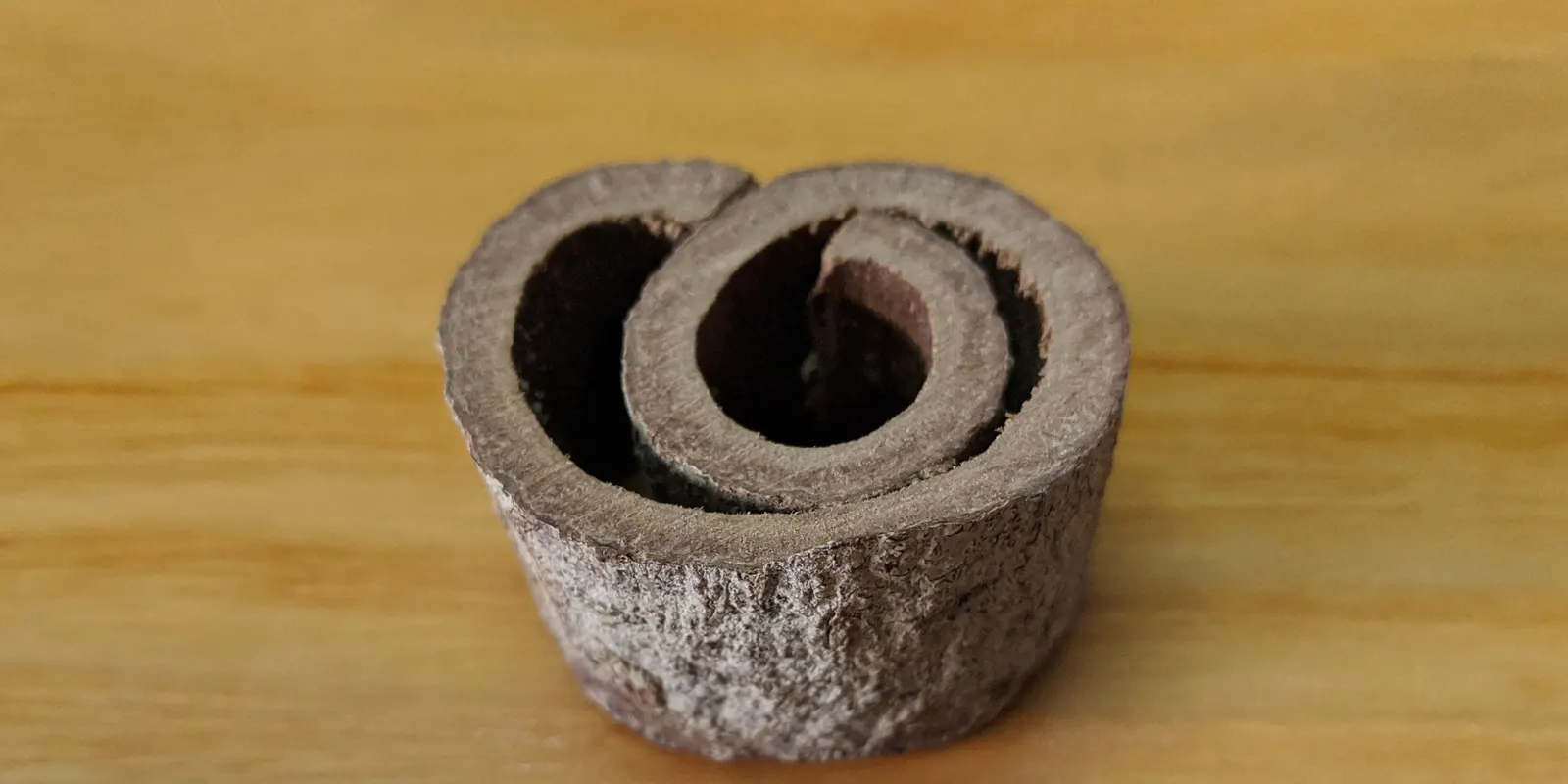
Vietnamese cinnamon is the dried bark of cassia-type cinnamon trees grown in the mountains of northern and central Vietnam, sold abroad as Saigon cinnamon. The ISO standard for cassia and US food regulations assign it to Cinnamomum loureiroi, while Vietnam’s own grower guidance names the cultivated tree C. cassia. The bark is peeled by hand in spring and autumn from trees grown for 10 to 15 years or more.
Quick facts
- Species
- Cinnamomum loureiroi in the ISO trade standard and US regulations2,3,1Vietnam’s 2022 grower guidance names the cultivated tree C. cassia
- Part used
- Dried bark, sold as quills, broken pieces and powder1
- Grown in
- Yên Bái, Lào Cai, Quảng Ninh, Thanh Hoá, Nghệ An, Quảng Nam, Quảng Ngãi1Seed-source areas named by the Ministry of Agriculture; pre-2025 province names
- Peeling seasons
- Spring, March–April · autumn, August–October1
- Tree age at harvest
- Selective harvests from year 10–12; main harvest of trees over 15 years1
- Exports, 2025
- 120,295 tonnes, US$300.2 million5as reported by the Vietnam Pepper and Spice Association
- Largest markets, 2025
- India 45,184 t · United States 13,583 t · Bangladesh 10,202 t5
Where Vietnamese cinnamon grows
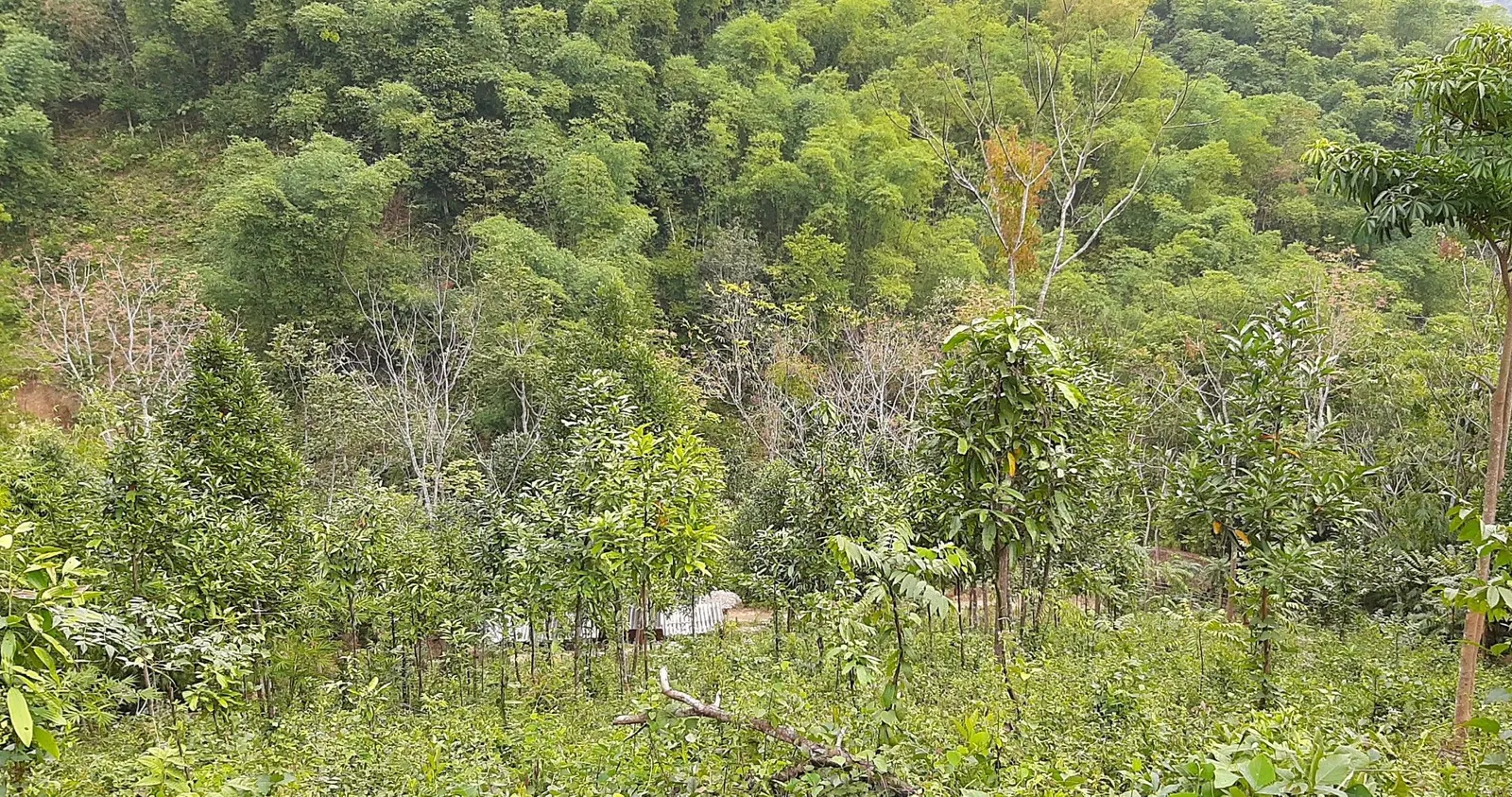
Vietnamese cinnamon is a mountain crop of the north and the centre. Vietnam’s Ministry of Agriculture and Rural Development (MARD) lists the areas where the trees grow best, with thick bark and high oil content, as seed sources for new planting.1 They run from Lào Cai (Lao Cai) and Yên Bái (Yen Bai) in the northwest to Quảng Ngãi (Quang Ngai) in the south-central region.
A 2024 trade report put the country’s planted area at “up to 180,000 hectares”, concentrated in Yên Bái, Lào Cai, Thanh Hoá, Nghệ An, Quảng Ninh and Quảng Nam.9

| Area | Province in sources | Province since 2025 | Growing areas named by MARD | Geographical indication |
|---|---|---|---|---|
| Northwest | Yên Bái | Lào Cai | Văn Yên (Van Yen), Trấn Yên | Văn Yên cinnamon, 20106 |
| Northwest | Lào Cai | Lào Cai | Bắc Hà, Văn Bàn, Bảo Yên, Bảo Thắng | — |
| Northeast | Quảng Ninh | Quảng Ninh | Đầm Hà, Hải Hà, Tiên Yên | — |
| North Central | Thanh Hoá | Thanh Hoá | Thường Xuân | — |
| North Central | Nghệ An | Nghệ An | Quế Phong, Quỳ Châu | — |
| South Central | Quảng Nam | Đà Nẵng city | Nam Trà My, Bắc Trà My (Tra My) | Trà My cinnamon, October 20117 |
| South Central | Quảng Ngãi | Quảng Ngãi | Trà Bồng (Tra Bong) | Trà Bồng cinnamon, 23 November 20208 |
Province names reflect Vietnam’s 2025 administrative merger, which folded Yên Bái into Lào Cai and Quảng Nam into Đà Nẵng city; many sources, labels and geographical indications still use the former province names.10 The growing areas are the district names used in the 2022 guidance.1
Three of these areas hold a geographical indication, which ties the product’s name to its place of origin: Văn Yên, Trà My and Trà Bồng. When a label names one of them, it names a place within Vietnam, not just the country. The two best-documented origins have their own pages: Yên Bái and Quảng Nam.
From tree to bark: how Vietnamese cinnamon is harvested
Cinnamon is harvested over many years, not in a single cut. Under MARD’s 2022 guidance, thinnings yield bark from year 4–5 (and again at 7–8 and 9–10), selective harvests come at years 10–12 and 14–15, and the main harvest takes trees over 15 years old.1
Bark is peeled in two seasons: spring, March–April, and autumn, August–October. A week before felling, the bark is girdled around the base to reduce its water content. It is then peeled in sections 40–60 cm long, washed, sorted and sun-dried on tarpaulins, never on bare ground or roads.1
Traditional practice could differ. Đỗ Tất Lợi’s Vietnamese botanical reference describes quế Thanh bark traditionally being cured for 3–7 days in baskets lined with banana leaves, where Ceylon and Chinese cinnamon were simply sun-dried.11
- 01Place
Mountain districts
Seed-source areas named by the Ministry of Agriculture run from Văn Yên in Yên Bái to Trà Bồng in Quảng Ngãi.1
- 02Plant
A tree grown for its bark
Thinnings yield bark from year 4–5; selective harvests come at years 10–12 and 14–15; the main harvest takes trees over 15 years old.1
- 03Harvest
Two peeling seasons
Bark is girdled a week before felling and peeled in 40–60 cm sections, in spring (March–April) or autumn (August–October).1
- 04Process
Washed and sun-dried
Bark is washed, sorted and dried on tarpaulins — never on bare ground — then bundled.1
- 05Grade
Graded by position and thickness
National guidance grades bark by where it grew on the tree and by thickness: A over 5 mm, B 2.5–5 mm, C under 2.5 mm.1
- 06Use & world
Into world trade
Quills, broken bark and powder; India, the United States and Bangladesh were the largest buyers in 2025.5
The tree itself and each harvesting step are covered in detail in the cinnamon tree and how bark is harvested.
Grades and forms: from bark to jar
MARD grades peeled bark in two ways: by where on the tree it grew, and by how thick it is.1
| Grade by position | Vietnamese name | Where the bark comes from | Character |
|---|---|---|---|
| Grade 1 | Quế Trung Châu | Main trunk, from 1 m above the base up to the first branches (trees over 20 cm in diameter) | Thick, oily, straight, few holes |
| Grade 2 | Quế Thượng Biểu | Upper trunk and large branches | More cracks and holes; less oil than grade 1 |
| Grade 3 | Quế Hạ Căn | Base of the trunk, below 1 m (trees over 20 cm in diameter) | Thick but less oily, with a thick outer layer |
| Grade 4 | Quế Chi | Small branches | Not described |
| Grade by thickness | Thickness | Length | Common requirements |
|---|---|---|---|
| A | over 5 mm | 40–60 cm | Natural aroma, spicy-sweet taste; not crushed, not mouldy, no insect damage |
| B | 2.5–5 mm | 40–60 cm | Same as A |
| C | under 2.5 mm | 40–60 cm | Same as A |
| Broken (quế vụn) | — | — | Broken pieces sorted out of grades A, B and C |
These are the grades in Vietnam’s national technical guidance for growers.1 Export contracts may specify bark differently; we have not found a published, sourced list of Vietnamese export grade names, so none is given here.
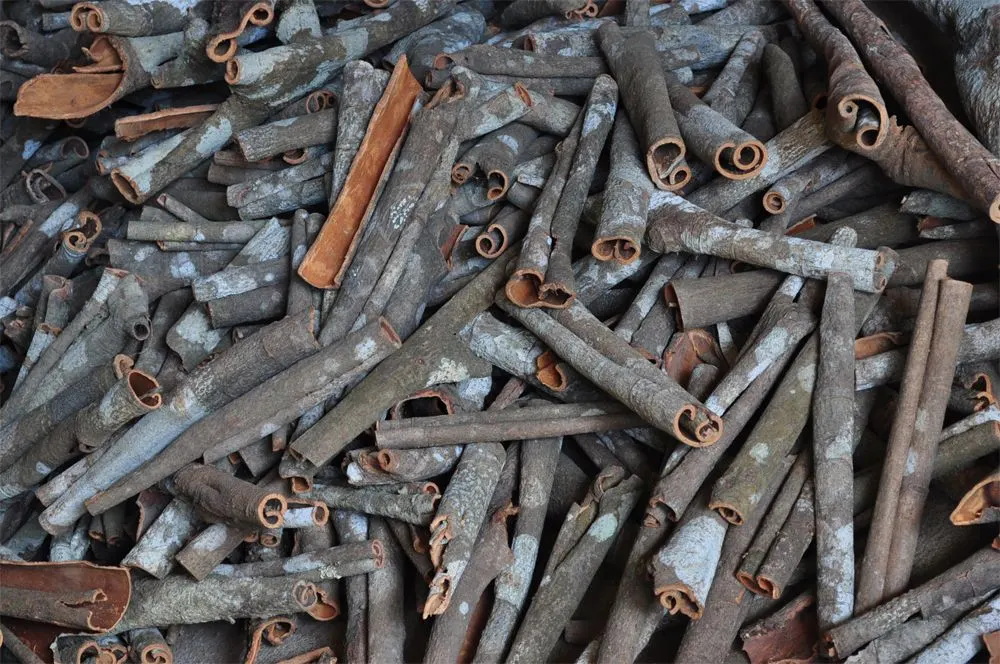
Whole bark leaves the farm as quills bundled tightly and tied at both ends; broken bark goes into sacks, including jumbo bags of 150–200 kg.1 Europe buys both whole sticks and crushed or ground cinnamon, and Indonesia, Vietnam and Sri Lanka are its three main suppliers.12 Ground Saigon cinnamon is the same dried bark, milled to a powder.

Vietnam’s cinnamon in numbers
Export figures come from the Vietnam Pepper and Spice Association (VPSA), as reported in the Vietnamese press. Each row is data as of the year shown.
| Year | Exports (tonnes) | Value (US$) | Change on the year before | Source |
|---|---|---|---|---|
| 2023 | nearly 90,000 | over 260 million | — | 13 |
| 2024 | 99,874 | 274.5 million | +11.7% volume, +5.2% value | 14 |
| 2025 | 120,295 | 300.2 million | +20.4% volume, +9.4% value | 5 |
VPSA described 2025 as the most successful year the industry has had. India bought 45,184 tonnes, 37.6% of the volume, followed by the United States with 13,583 tonnes and Bangladesh with 10,202 tonnes. Vietnam also imported 5,034 tonnes of cinnamon worth US$11.3 million, mainly from Indonesia and China.5
According to the Vietnam Pepper and Spice Association, Vietnam has been the world’s largest cinnamon exporter since 2021, with about 95% of the market in India, 36.5% in the United States and 35% in Europe.13 These are the association’s own estimates; we have not found an independent dataset that tests them.
Production is harder to pin down. A 2024 report from the Vietnam Chamber of Commerce and Industry put standing reserves at 900,000–1,200,000 tonnes and the average annual harvest at 70,000–80,000 tonnes.9 Export volumes can exceed production estimates: harvest estimates and VPSA’s export statistics measure different things, and Vietnam also imports cassia (5,034 tonnes in 2025).5
Which species is Vietnamese cinnamon?
The international standard for cassia (ISO 6538) and the US list of spices (21 CFR 182.10) assign Saigon cinnamon to Cinnamomum loureiroi.2,12,3 Vietnam’s own technical guidance for cinnamon growers, issued by the Ministry of Agriculture in 2022, names the cultivated tree Cinnamomum cassia.1 A Vietnamese botanical reference by Đỗ Tất Lợi records both species in the country.11
| Document | What it calls Vietnam’s cinnamon tree |
|---|---|
| ISO 6538:1997, adopted in Vietnam as TCVN 8957:2011 | “Vietnamese type” cassia, C. loureirii2,15,12 |
| 21 CFR 182.10, US list of spices | “Cassia, Saigon” and “Cinnamon, Saigon”, C. loureirii Nees3 |
| Plants of the World Online, Kew | C. loureiroi Nees, accepted name; native to Vietnam16 |
| MARD technical guidance, 2022 | “Cinamomum cassia BL.” (spelled so in the document)1 |
| Đỗ Tất Lợi, Những cây thuốc và vị thuốc Việt Nam | quế Thanh is C. loureirii; C. cassia is also grown in Vietnam11 |
Loureirii and loureiroi are two spellings of the same name. It honours João de Loureiro (1717–1791), a Jesuit missionary who described the flora of Vietnam in detail.17
Đỗ Tất Lợi places quế Thanh along the Trường Sơn range from Thanh Hoá to Quảng Nam and Quảng Ngãi, and records C. cassia as grown in Vietnam and in Guangdong and Guangxi in China.11 A 2004 field survey pointed the same way: it suggested that bark from Trà My comes from C. loureiroi, while bark from Yên Bái may come from C. cassia. The two barks looked alike, but the Trà My bark held much more oil.18
Because both trees grow in Vietnam and both reach the market as Vietnamese cassia, the trade name alone does not identify the species.
On composition, one spice reference gives the bark’s essential-oil content as 1–7%, mostly cinnamaldehyde with only traces of eugenol.17 CBI, the Dutch government’s import-promotion agency, describes C. loureiroi as having the highest essential-oil concentration of the cinnamon species.12
Why it’s called Saigon cinnamon
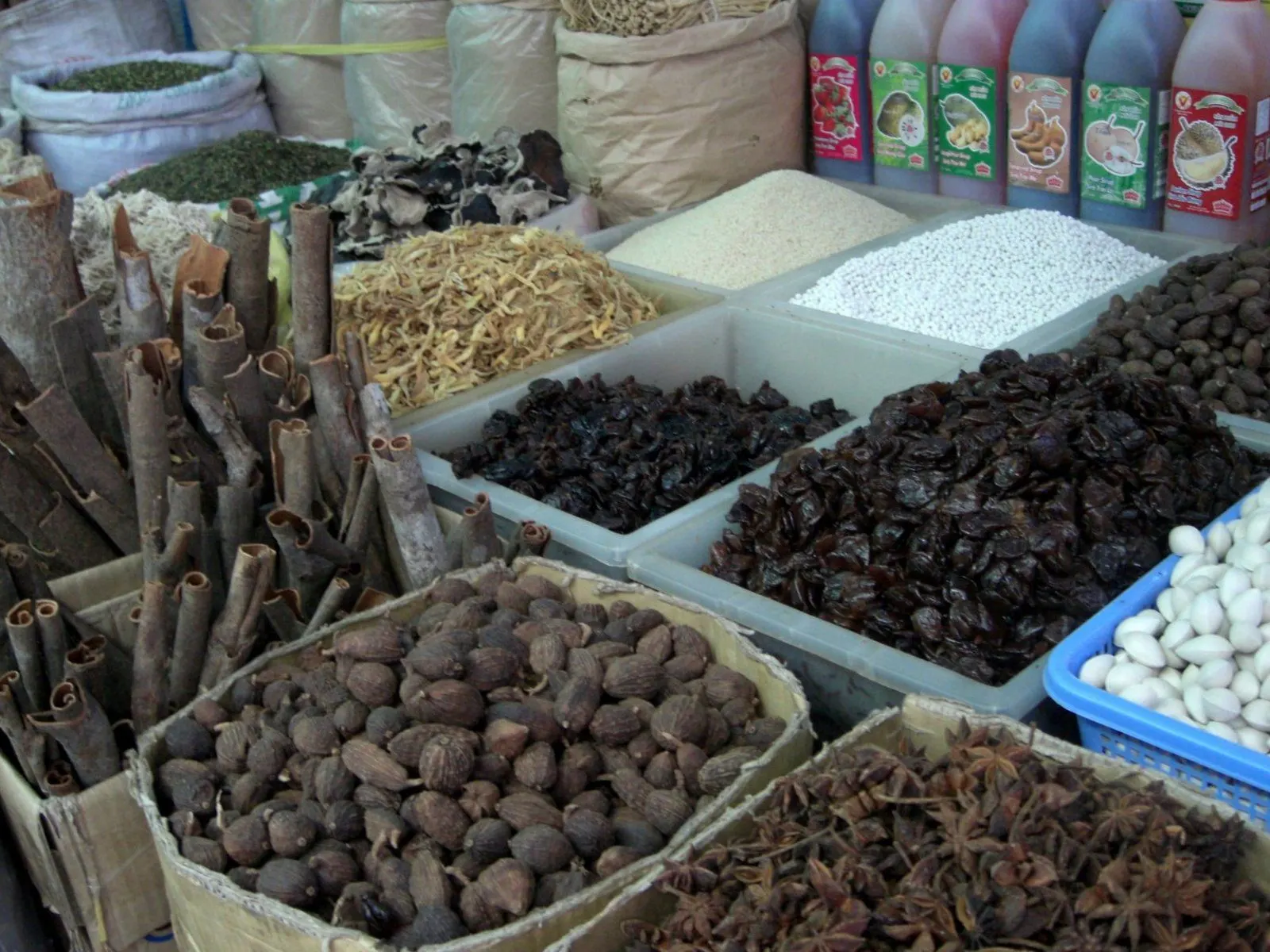
Saigon cinnamon, Vietnamese cinnamon and Vietnamese cassia are trade names for the same product.4 The name comes from Saigon, the port through which the bark was traded, not from where it grows: the trees grow much farther north.17,4 In Vietnamese the bark goes by regional names instead, such as quế Thanh, quế Trà My, quế Trà Bồng and quế Quỳ.4

War in Vietnam disrupted production, and Vietnamese cinnamon has since returned to world trade, including to the United States.4 The United States lifted its trade embargo on Vietnam on 3 February 1994.19 At home, cinnamon bark is a key ingredient of the broth for phở.4
Saigon cinnamon is a cassia
In the spice trade, “cassia” means cinnamon bark from Cinnamomum species other than Ceylon cinnamon (C. verum), and ISO 6538 covers Chinese, Indonesian and Vietnamese cassia in one specification.2,12 US regulations list Saigon cinnamon twice, as “Cassia, Saigon” and “Cinnamon, Saigon”, so it is both a cassia and, legally, a cinnamon.3 What the word covers, and how the cassias differ, is explained in What is cassia cinnamon?
How it compares
Saigon cinnamon belongs to the cassia group, alongside Chinese (C. cassia) and Indonesian (C. burmannii) cinnamon; Ceylon or “true” cinnamon is a different species, C. verum, produced mainly in Sri Lanka.20,12 Lab tests of authenticated bark found substantial coumarin in all three cassia species, Vietnamese included, but only traces in Ceylon cinnamon.20 For a side-by-side look at species, bark, oil and coumarin, see Saigon vs Ceylon vs cassia cinnamon.
Sourcing Vietnamese cinnamon
These are the points buyers usually specify, with the reference behind each. We do not name, rank or recommend suppliers.
- Form and grade: whole quills or sticks, broken bark, or powder; for whole bark, the thickness grade (A, B or C) from the national guidance.1
- Standard: ISO 6538 for Vietnamese-type cassia, adopted in Vietnam as TCVN 8957:2011. Their numeric limits are in paid texts and are not reproduced here.2,15
- European quality minima: the European Spice Association’s minimums for unprocessed cinnamon are moisture no more than 14%, total ash no more than 7.0%, acid-insoluble ash no more than 2.0%, and volatile oil of at least 0.7–1.0 ml per 100 g, depending on the species.12
- Cleanliness: the American Spice Trade Association’s cleanliness specifications limit insects, excreta, mould and extraneous matter.12
- Certification: when bark is ground or packed in the country of origin, buyers often ask for a GFSI-recognised food-safety scheme: FSSC 22000, BRCGS Food Safety, IFS Food or SQF. Organic imports into the EU need an electronic certificate of inspection; Fairtrade is a niche.12
- Origin: whether the bark carries one of the three geographical indications listed above.
What this page does not cover
This page describes what Vietnamese cinnamon is, where it grows and how it is traded. It gives no health or dietary advice and does not say how much cinnamon anyone should eat; questions about health effects or medication are for a doctor or pharmacist. Coumarin measurements are covered in coumarin in cinnamon.
Prices are not covered, because we found no published price series we could cite. Exporters’ own grade names are not listed either: no standard source defines them. We have not visited farms, tested samples or checked any supplier, and we name no companies.
Frequently asked questions
Is Ceylon cinnamon from Vietnam?
No. Ceylon, or “true”, cinnamon is Cinnamomum verum, and it comes mainly from Sri Lanka. The cinnamon Vietnam grows and exports is cassia-type bark. A Vietnamese botanical reference records C. verum (under its synonym C. zeylanicum) in Vietnam only as rare, scattered trees in Thanh Hoá and Nghệ An.
Which cinnamon is Saigon cinnamon?
Saigon cinnamon is Vietnamese cassia. US regulations list it under both “Cassia, Saigon” and “Cinnamon, Saigon” as Cinnamomum loureirii, an older spelling of C. loureiroi. It grows in the mountains of northern and central Vietnam, not around Saigon. Vietnam’s own guidance names the cultivated tree C. cassia; see Which species is Vietnamese cinnamon?
Is cassia cinnamon real cinnamon?
Yes, in trade and regulatory terms. Cassia is the bark of Cinnamomum trees, and the US list of spices includes Chinese, Padang or Batavia (Indonesian) and Saigon cassia, with Chinese and Saigon also listed as cinnamon. “True cinnamon” is the market name for one species, Ceylon cinnamon. More in What is cassia cinnamon?
Image credits
- “Vietnam cinnamon tree bark” by Phó Nháy, via Wikimedia Commons, licensed CC BY-SA 4.0. Cropped (protractor removed) and resized; converted to WebP.
- “Rừng quế, lát, luồng tại bản Phe” by Hà Nghĩa VN, via Wikimedia Commons, licensed CC BY-SA 4.0. Cropped (a person at the right edge removed) and resized; converted to WebP.
- “Vietnamesischer Cassiazimt” by Cinnea, via Wikimedia Commons, licensed CC BY-SA 4.0. Resized; converted to WebP.
- “Cannelle, noix de muscade, anis au marché de Ho Chi Minh” by Dinkum, via Wikimedia Commons, licensed CC0. Resized; converted to WebP.
Sources
- 1
Hướng dẫn kỹ thuật trồng, chăm sóc, khai thác cây Quế (kèm Quyết định 14/QĐ-BNN-TCLN)
Technical guidance for growers: seed-source areas (III.1), harvest seasons (VI.2b), harvesting and bark grading (VIII), processing and packing (IX). Names the cultivated tree “Cinamomum cassia BL.” (sic).
- 2
Title and status only. The standard is paid; its numeric limits are not reproduced here. ISO/FDIS 6538 has been at stage 50.00 since 2026-09-11.
- 3
21 CFR 182.10 — Spices and other natural seasonings and flavorings
Lists “Cassia, Saigon” and “Cinnamon, Saigon” as Cinnamomum loureirii Nees.
- 4
Used for names and history only, never for numbers.
- 5
Xuất khẩu quế đem lại 300 triệu USD
2025 exports, markets and imports, as reported by VPSA.
- 6
Văn Yên cinnamon geographical indication granted in 2010.
- 7
Trà My cinnamon geographical indication granted October 2011.
- 8
Quế Trà Bồng — từ non cao đi khắp năm châu
Trà Bồng cinnamon geographical indication granted 23 November 2020.
- 9
Indonesia is Vietnam’s largest cinnamon import market
Planted area “up to 180,000 hectares” and the main growing provinces.
- 10
Nghị quyết 202/2025/QH15 về việc sắp xếp đơn vị hành chính cấp tỉnh
Yên Bái merged into Lào Cai; Quảng Nam into Đà Nẵng city; Kon Tum into Quảng Ngãi; Bắc Kạn into Thái Nguyên; Bình Phước into Đồng Nai (point 17; checked against the hoatieu.vn copy of the text on 2026-10-07). In force 1 July 2025.
- 11
Những cây thuốc và vị thuốc Việt Nam — Cây quế
Botany only: which Cinnamomum species occur in Vietnam and the traditional curing of quế Thanh. The medicinal sections are not used.
- 12
Entering the European market for cinnamon
ESA quality minima, ASTA cleanliness, certifications, market structure. Places Vietnamese cinnamon in the “Central Highlands”, which MARD’s list of growing areas does not support; that statement is not used.
- 13
Vietnam strives to remain world’s biggest cinnamon exporter
2023 exports and VPSA’s market-share statements. “Largest exporter” is VPSA’s claim and is attributed as such.
- 14
Xuất khẩu quế mang về hàng trăm triệu USD
2024 export figures read from a search excerpt; the page blocks automated access.
- 15
TCVN 8957:2011 (ISO 6538:1997) Quế Việt Nam, quế Indonesia, quế Trung Quốc
Identical adoption of ISO 6538:1997. Numeric limits not read (paid text).
- 16
The page blocks automated access; accepted name and native range were read from a search excerpt of it and need a browser check.
- 17
Vietnamese cassia (Cinnamomum loureiroi)
Trade-name history (Saigon as the port), João de Loureiro, bark oil range.
- 18
Field Survey of Cinnamon in Viet Nam
The authors write that the attribution of Yên Bái bark to C. cassia “might be suggested”; we report it as a suggestion, not a finding.
- 19
- 20
Abstract read. Per-species coumarin values are taken from the review by Lončar et al. (2020), Table 4, which reproduces them.