How it's made
What Tree Does Cinnamon Come From? The Vietnamese Tree, From Planting to Peeled Bark
Cinnamon is bark, and the bark comes from one genus of trees. This page follows Vietnam’s tree through its life: when it is thinned, when it is felled, how the bark comes off, and how it is dried and graded.
Quick answer
Cinnamon comes from the inner bark of several trees in the genus Cinnamomum, part of the laurel family. Ceylon cinnamon is C. verum; the cassias are C. cassia, C. burmannii and C. loureiroi. Vietnam’s tree is sold as Saigon cinnamon and named C. loureiroi in trade rules, though Vietnam’s own grower guidance calls it C. cassia. Its bark is peeled by hand from trees grown for 10 to over 15 years.
What tree does cinnamon come from?
Cinnamon is a spice obtained from the inner bark of several tree species in the genus Cinnamomum.1 The genus belongs to the laurel family, Lauraceae.2,3 No single “cinnamon tree” exists: four species are named in US food rules, and researchers group three of them together as cassia.4,5
| Species | Group | Name in the US list of spices |
|---|---|---|
| C. verum (syn. C. zeylanicum) | “True” or Ceylon cinnamon5 | Cinnamon, Ceylon4 |
| C. cassia | Cassia5 | Cassia, Chinese · Cinnamon, Chinese4 |
| C. burmannii | Cassia5 | Cassia, Padang or Batavia4 |
| C. loureiroi (rule spelling loureirii) | Cassia5 | Cassia, Saigon · Cinnamon, Saigon4 |
The international standard for cassia, ISO 6538, covers the Chinese, Indonesian and Vietnamese types in one specification.6 Ceylon cinnamon comes mainly from Sri Lanka7 and is outside this page; how the species differ is set out in Ceylon vs Saigon cinnamon.
From tree to bark at a glance
- 01Place
Mountain districts
Seed-source areas named by the Ministry of Agriculture run from Văn Yên in Yên Bái to Trà Bồng in Quảng Ngãi.8
- 02Plant
A tree grown for its bark
Thinnings yield bark from year 4–5; selective harvests come at years 10–12 and 14–15; the main harvest takes trees over 15 years old.8
- 03Harvest
Two peeling seasons
Bark is girdled a week before felling and peeled in 40–60 cm sections, in spring (March–April) or autumn (August–October).8
- 04Process
Washed and sun-dried
Bark is washed, sorted and dried on tarpaulins — never on bare ground — then bundled.8
- 05Grade
Graded by position and thickness
National guidance grades bark by where it grew on the tree and by thickness: A over 5 mm, B 2.5–5 mm, C under 2.5 mm.8
- 06Use & world
Into world trade
Quills, broken bark and powder; India, the United States and Bangladesh were the largest buyers in 2025.9
Which tree is Vietnamese cinnamon?
In trade and US rules, Vietnam’s cinnamon is Cinnamomum loureiroi, the “Vietnamese type” of cassia.6,4 Kew’s Plants of the World Online gives C. loureiroi Nees as the accepted name, with Vietnam as its native range.10 Vietnam’s 2022 technical guidance for growers, however, names the cultivated tree “Cinamomum cassia BL.” (sic).8
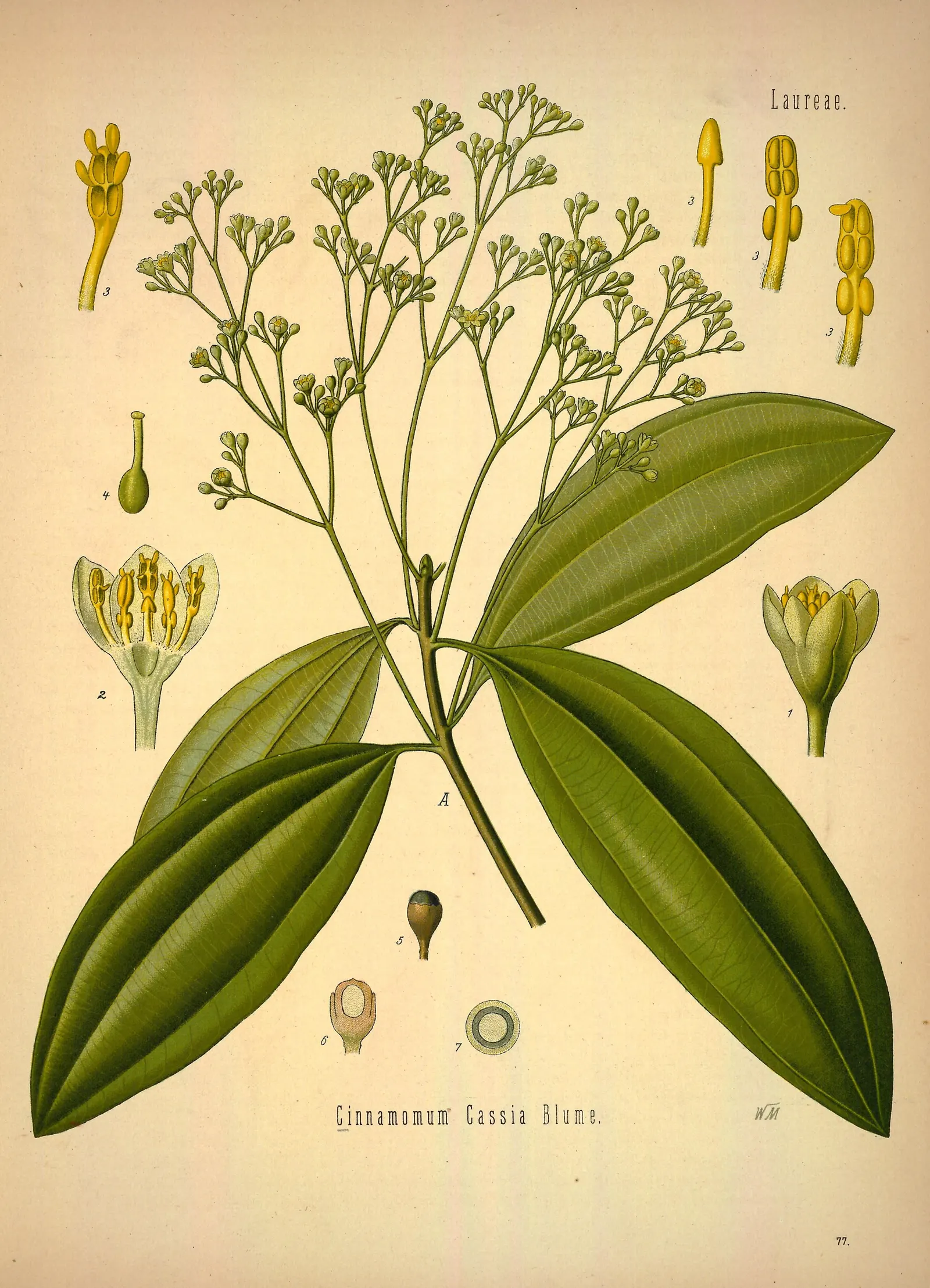
_BHL303718.jpg)
Đỗ Tất Lợi’s reference on Vietnamese plants says the identification of the country’s cinnamon species is not yet certain; it records quế Thanh as C. loureirii and C. cassia as growing scattered across Vietnam and planted in many places.3 A 2004 field survey suggested that bark from Trà My comes from C. loureiroi and bark from Yên Bái may come from C. cassia.11 Why one trade name covers two species is explained on the Vietnamese cinnamon guide.
loureiroispecies name
What the tree looks like
| Part | Description |
|---|---|
| Leaves | Roughly oval, narrowed at both ends; blade 12–15 cm long and about 5 cm wide, with three clear veins running from stalk to tip3 |
| Flowers | White, in clusters (panicles) at the leaf axils or branch tips3 |
| Fruit | Egg-shaped, about 1 cm long; green, turning purplish brown when ripe3 |
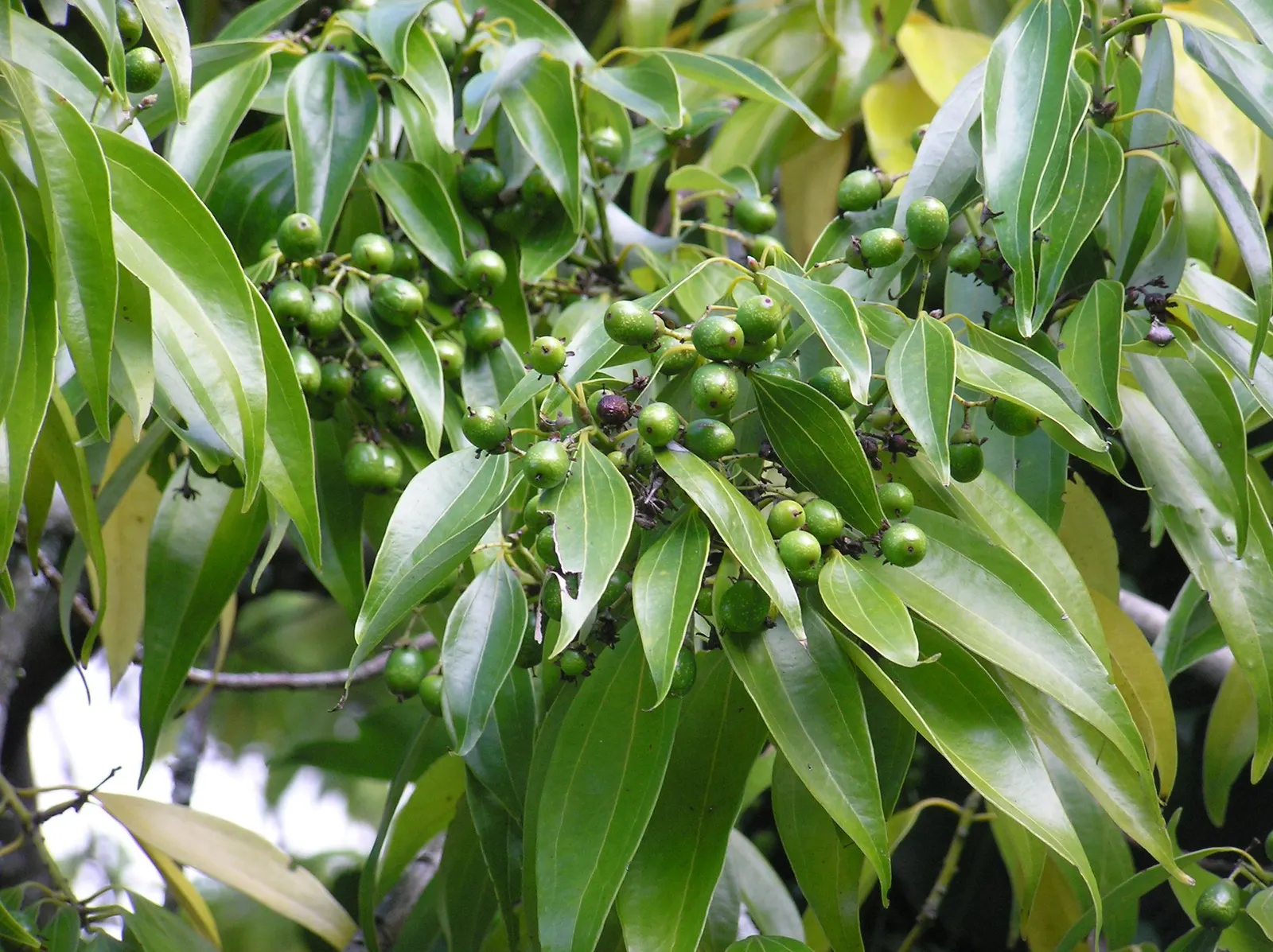
.jpg)
How long does a cinnamon tree grow before harvest?
A stand is harvested over many years, not in one cut. Vietnam’s Ministry of Agriculture and Rural Development (MARD) plants 1,650–2,500 trees per hectare where the aim is a main harvest, and up to 6,666 where bark will come mainly from thinnings.8
| Tree age (years) | Operation | Trees left per hectare |
|---|---|---|
| 4–5 | First thinning: crooked, diseased and suppressed trees removed | 31–40% of trees removed in stands over 5,000 per hectare; fewer in sparser stands8 |
| 7–8 | Second thinning | 2,000–2,5008 |
| 9–10 | Third thinning | 1,500–1,8008 |
| 10–12 | First selective harvest | 1,500–1,8008 |
| 14–15 | Second selective harvest | 1,000–1,3008 |
| 20 onward | Further selective harvests | 600–9008 |
| Over 15 | Main harvest (the alternative to selective harvesting) | None: all trees over 15 years are harvested8 |
Thinned trees are not wasted: their bark is peeled and cut to product size, and their leaves are collected for essential-oil distillation.8 An older account is blunter about age: harvesting can start after five years, but growers held that the older the tree — 20 to 30 years or more — the better the bark.3
When is cinnamon bark harvested?
MARD sets two peeling seasons, spring and autumn, and times harvests to the same seasons as thinning, just before the tree starts a new growth period.8 Đỗ Tất Lợi gives slightly later months for the traditional peel, when the trees are full of sap and the bark lifts cleanly.3
| Source | Jan | Feb | Mar | Apr | May | Jun | Jul | Aug | Sep | Oct | Nov | Dec |
|---|---|---|---|---|---|---|---|---|---|---|---|---|
| Spring season, MARD 20228Mar–Apr | in season | in season | ||||||||||
| Autumn season, MARD 20228Aug–Oct | in season | in season | in season | |||||||||
| Traditional peeling months3Apr–May, Sep–Oct · older account, not current guidance | in season | in season | in season | in season |
How is cinnamon bark peeled?
- Girdle the tree a week ahead. Bark is cut around the base one week before harvest, to reduce the water in the bark and improve its quality.8
- Peel the first section standing. A ring is cut around the trunk close to the ground, a second ring 40–60 cm higher, and a straight vertical cut joins them; the bark is then eased off with a knife.8
- Fell the tree. It must come down without damaging the trees left standing.8
- Peel the rest in 40–60 cm sections. The inner face must not be scratched, the ends must not split and the bark must not be holed; each piece is wiped clean and the moisture inside dried off.8
- Stack and carry out. Pieces are packed tightly together to be carried out of the forest.8
The traditional method recorded by Đỗ Tất Lợi is similar but peels higher before felling: harvesters built a stepped scaffold 4–5 m high around the tree, peeled the whole standing trunk in pieces 40–50 cm long, and only then felled it. In Quảng Nam and Quảng Ngãi, one ring was taken near the base, 20–30 cm above the ground, and the rest about a month later.3
Does harvesting cinnamon kill the tree?
Yes, for the trees that are harvested. Both MARD’s guidance and the traditional method peel part of the bark from the standing tree, then fell it to strip the rest.8,3 What survives is the stand: thinnings and selective harvests take some trees and leave the rest to grow on, while a main harvest takes every tree over 15 years old.8
How is the bark dried and cured?
Under MARD’s guidance, fresh bark is taken straight to a washing area to remove dust and mould spores, and sorted as it is washed. It must be dried on tarpaulins, never on bare ground or on roads, and is tied into bundles once dry.8 Dried and shaped bark is then graded and packed: quills in tight bundles tied at both ends, broken pieces in sacks.8
In Thanh Hoá, Nghệ An and Hà Tĩnh, quế Thanh was traditionally cured before drying — a recorded tradition, not current guidance.3
| Step | What was done |
|---|---|
| Soak | Fresh bark soaked in water for a day, washed and drained3 |
| Cure | Packed into large baskets lined with about 5 cm of wilted banana leaves, covered with another layer and tied shut; turned daily, for about 3 days in the hot season and 7 in the cold3 |
| Straighten | Soaked again for an hour, pressed flat between bamboo frames, then bound onto straight bamboo tubes; the inner face was wiped twice a day until dry3 |
| Total time | 15–16 days in the hot season, a month or sometimes two in the cold3 |
Only bark from the trunk and large branches was cured; bark from small branches was simply dried in the shade, as was Chinese cassia.3 The same account puts an average tree’s yield at 30 kg of good bark and 10 kg of medium, without a date or method.3
How is cinnamon bark graded?
One tree usually yields three or four grades, by where the bark grew; the table reads from the top of the tree down.8
| Part of the tree | Grade | Character |
|---|---|---|
| Small branches | Grade 4, Quế Chi | Not described8 |
| Crown and large branches | Grade 2, Quế Thượng Biểu | More cracks, holes and warping; less oil than grade 18 |
| Trunk, from 1 m up to the first branches | Grade 1, Quế Trung Châu | Thick, oily, straight, few holes (trees over 20 cm in diameter)8 |
| Base, below 1 m | Grade 3, Quế Hạ Căn | Thick but low in oil, with a thick outer layer (trees over 20 cm in diameter)8 |
Bark is also graded by thickness: A over 5 mm, B 2.5–5 mm and C under 2.5 mm, all in 40–60 cm lengths, with naturally fragrant, spicy-sweet bark free of crushing, mould and insect damage; broken pieces sorted out of A, B and C are sold as quế vụn.8 These are the grades in Vietnam’s national guidance for growers; we have not found a sourced list of export grade names. The traditional account draws the lines slightly differently, placing the base grade between 0.2–0.4 m and 1.2 m above the ground.3
Where do Vietnam’s cinnamon trees grow?
MARD’s guidance suits the tree to humid hills: over 1,800 mm of rain a year, air humidity above 80%, and 200–700 m altitude in the north and north-centre or 300–800 m in the south-centre. It avoids limestone, sandy and waterlogged soils.8 Seed-source areas named in the guidance — places where the tree grows well and gives thick, oil-rich bark — include the former districts of Văn Yên and Trấn Yên in Yên Bái and Nam Trà My and Bắc Trà My in Quảng Nam.8 Since 1 July 2025, Yên Bái is part of Lào Cai province and Quảng Nam part of Đà Nẵng city.12
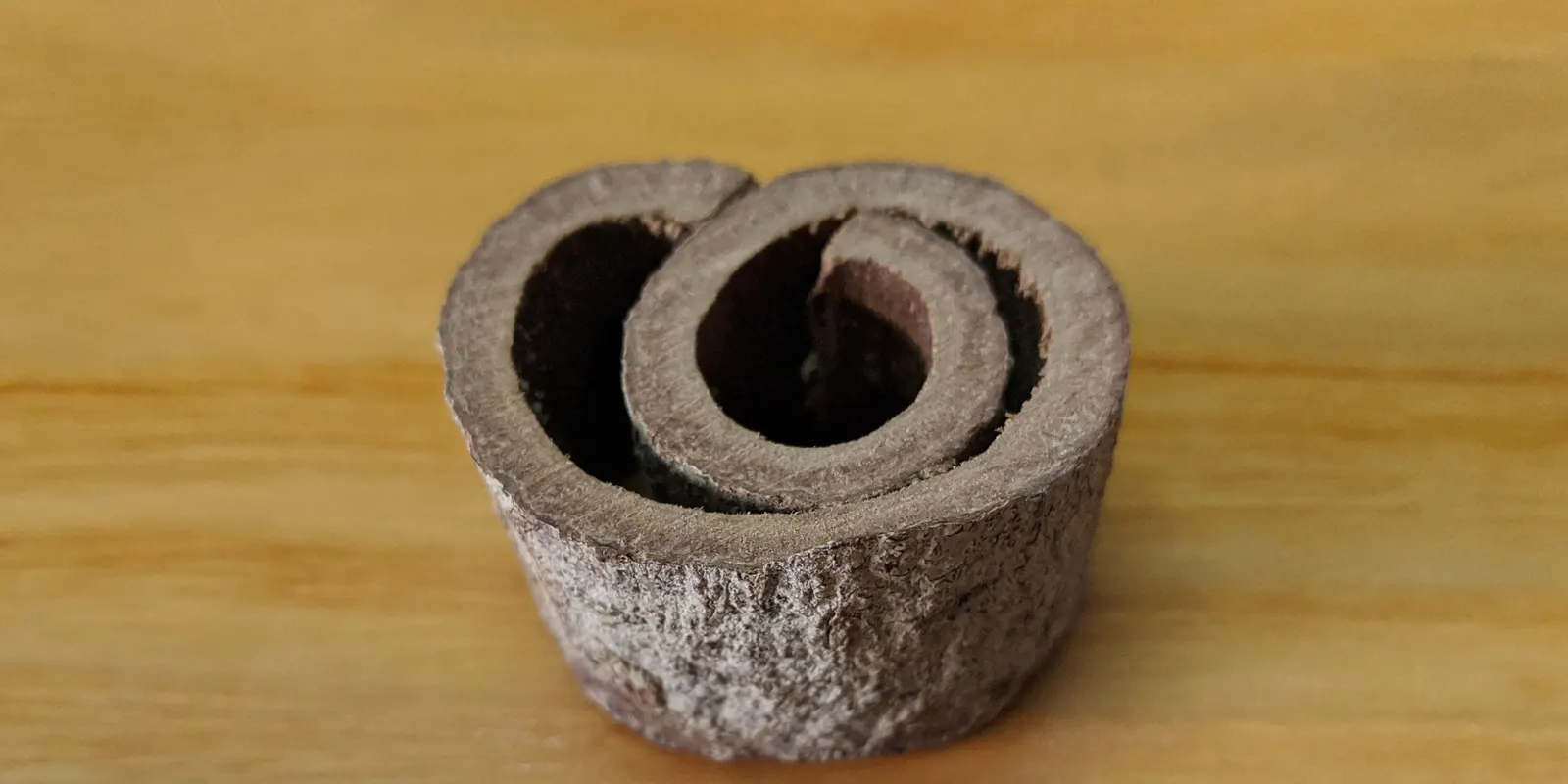

More on Yên Bái, Quảng Nam and all growing areas in the Vietnamese cinnamon guide.
What this page does not cover
Exports and buyer specifications are on the Vietnamese cinnamon guide; species comparisons on Ceylon vs Saigon cinnamon. This page gives no health or dietary advice, and we have not visited any plantation.
Frequently asked questions
Can you get cinnamon from any tree?
No. Cinnamon is the inner bark of trees in one genus, Cinnamomum. The US federal list of spices names four species: Ceylon cinnamon (C. zeylanicum, today usually called C. verum) and three cassias — Chinese (C. cassia), Padang or Batavia (C. burmannii) and Saigon (C. loureiroi). Vietnam’s cinnamon comes from the cassia side of that list.
Image credits
- “Köhler's Medizinal-Pflanzen in naturgetreuen Abbildungen mit kurz erläuterndem Texte (Plate 77) BHL303718” by Walther Müller (plate signed “W.M.”), in F. E. Köhler, Köhler’s Medizinal-Pflanzen (1887); scan: Biodiversity Heritage Library, via Wikimedia Commons, licensed Public domain. Resized; converted to WebP.
- “Cinnamomum loureirii Nees (AM AK276468)” by Bill Sykes / Auckland Museum, via Wikimedia Commons, licensed CC BY 4.0. Resized; converted to WebP.
- “Vietnam cinnamon tree bark” by Phó Nháy, via Wikimedia Commons, licensed CC BY-SA 4.0. Cropped (protractor removed) and resized; converted to WebP.
Sources
- 1
Bark description (Ceylon quills vs cassia bark), trade names. Used for description only.
- 2
Vietnamese cassia (Cinnamomum loureiroi)
Trade-name history (Saigon as the port), João de Loureiro, bark oil range.
- 3
Những cây thuốc và vị thuốc Việt Nam — Cây quế
Botany only: which Cinnamomum species occur in Vietnam and the traditional curing of quế Thanh. The medicinal sections are not used.
- 4
21 CFR 182.10 — Spices and other natural seasonings and flavorings
Lists “Cassia, Saigon” and “Cinnamon, Saigon” as Cinnamomum loureirii Nees.
- 5
Abstract read. Per-species coumarin values are taken from the review by Lončar et al. (2020), Table 4, which reproduces them.
- 6
Title and status only. The standard is paid; its numeric limits are not reproduced here. ISO/FDIS 6538 has been at stage 50.00 since 2026-09-11.
- 7
Entering the European market for cinnamon
ESA quality minima, ASTA cleanliness, certifications, market structure. Places Vietnamese cinnamon in the “Central Highlands”, which MARD’s list of growing areas does not support; that statement is not used.
- 8
Hướng dẫn kỹ thuật trồng, chăm sóc, khai thác cây Quế (kèm Quyết định 14/QĐ-BNN-TCLN)
Technical guidance for growers: seed-source areas (III.1), harvest seasons (VI.2b), harvesting and bark grading (VIII), processing and packing (IX). Names the cultivated tree “Cinamomum cassia BL.” (sic).
- 9
Xuất khẩu quế đem lại 300 triệu USD
2025 exports, markets and imports, as reported by VPSA.
- 10
The page blocks automated access; accepted name and native range were read from a search excerpt of it and need a browser check.
- 11
Field Survey of Cinnamon in Viet Nam
The authors write that the attribution of Yên Bái bark to C. cassia “might be suggested”; we report it as a suggestion, not a finding.
- 12
Nghị quyết 202/2025/QH15 về việc sắp xếp đơn vị hành chính cấp tỉnh
Yên Bái merged into Lào Cai; Quảng Nam into Đà Nẵng city; Kon Tum into Quảng Ngãi; Bắc Kạn into Thái Nguyên; Bình Phước into Đồng Nai (point 17; checked against the hoatieu.vn copy of the text on 2026-10-07). In force 1 July 2025.