Origin guide
Vietnamese Cashews: Where They Grow and How They Are Graded
Vietnam grows a small share of the world’s cashews and shells a large share of them. Its growing regions, harvest, processing chain, kernel grades and trade, with every figure sourced.

In short
Vietnam is the world’s largest exporter of shelled cashews, the kernels of Anacardium occidentale. It exported 766,585 tonnes in 2025 by preliminary customs data, but most of the nuts it shells are imported: 2.94 million tonnes in 2025, mainly raw nuts from Cambodia and West Africa. Its own trees grow from Đà Nẵng southwards, above all in the Southeast and in former Bình Phước province.
Quick facts
Most Vietnamese cashews are shelled in Vietnam from imported raw nuts: domestic nuts cover only about 10% of what the factories need.11 Vietnam is the world’s largest exporter of shelled cashews and the top supplier to both the European Union and the United States, according to the US Department of Agriculture.1 In 2025 it exported 766,585 tonnes of cashews worth US$5.23 billion4 and imported 2,941,858 tonnes,2 mainly raw nuts,5 by preliminary customs data. This guide covers where Vietnam’s own cashews grow, when they are harvested, how raw nuts become graded kernels, and where the kernels go. For the tree, the fruit and the world picture, start with Where do cashews come from?
Vietnam’s cashews in numbers
Each row gives its period and source. Figures are as of 7 October 2026; the 2024 and 2025 customs figures are preliminary.
| Indicator | Value | Period | Source |
|---|---|---|---|
| Exports | 723,808 t, US$4.34 billion | 2024, preliminary | Vietnam Customs12 |
| Exports | 766,585 t, US$5.23 billion (+5.7% volume, +20.4% value) | 2025, preliminary | Vietnam Customs4 |
| Average export value | about US$6,822 per tonne | 2025 | Báo Đầu tư, from customs data13 |
| Imports | 2,941,858 t, US$4.49 billion (+17.7% volume, +39.3% value) | 2025, preliminary | Vietnam Customs2 |
| Import origins, by volume | Cambodia 32.9% · Côte d’Ivoire 25.3% · Nigeria 9.7% · Ghana 8% | 2025 | Báo Đầu tư, citing customs14 |
| Domestic raw nuts, share of processing needs | about 12% · about 10% | January 2024 · January 2026 | VINACAS via Viet Nam News15 · industry via Viet Nam News11 |
| Raw cashew production | 306,185 t, in shell | calendar year 2024 | FAOSTAT16 |
| Raw cashew production | 340,000 t | crop year 2024/25 | INC, via CBI8 |
| Raw cashew production | over 345,000 t, from 300,000 ha harvested | 2023 | Ministry of Agriculture, via Viet Nam News15 |
The three production figures cover different periods and are compiled in different ways, so they are shown side by side rather than reconciled. By FAO data cited by USDA, Vietnam grew about 7% of the world’s cashews in 2024, while Côte d’Ivoire, the largest producer, grew 22%.1 Import and export tonnages are not directly comparable either: the imports are mainly raw nuts in the shell, the exports mainly shelled kernels. The average export value is the only price-like figure on this page; it is total value divided by volume, not a market price.
Where cashews grow in Vietnam
Cashew is grown from Đà Nẵng southwards. A grower guide from the Institute of Agricultural Science for Southern Vietnam (IAS) describes three main regions:10
| Region | Conditions, as the IAS guide describes them |
|---|---|
| Southeast (Đông Nam Bộ) | The most suitable and stable growing region |
| Central Highlands (Tây Nguyên) | Low temperatures at flowering, and drought |
| South Central Coast (Duyên hải Nam Trung Bộ) | Cold rain at flowering, irregular drought and poor soils |
The crop needs a dry season of four to six months, a mean monthly temperature of about 27 °C, 1,000–1,500 mm of rain that does not fall during flowering, and altitudes below 600 m.10
In 2023 Vietnam had an estimated 314,000 ha of cashew planted, 8,300 ha less than in 2022, with 300,000 ha harvested and more than 345,000 t produced, according to the Ministry of Agriculture and Rural Development.15 The Southeast has more than 192,000 ha, 61% of the national area.6
Bình Phước
Bình Phước (Binh Phuoc) holds close to half of Vietnam’s cashew area.9 Its main cashew areas are the former districts of Bù Gia Mập, Bù Đăng, Phú Riềng and Đồng Phú.9 The provincial statistics office publishes a five-year series:7
| Year | Cashew planted area (ha) | Production (t, raw nuts) |
|---|---|---|
| 2020 | 139,868 | 189,015 |
| 2021 | 151,180 | 235,610 |
| 2022 | 152,007 | 171,876 |
| 2023 | 149,647 | 195,257 |
| 2024 (preliminary) | 148,239 | 155,053 |
In 2024 the harvested area was 145,043 ha.7 Output swings more than area: production fell from 195,257 t in 2023 to 155,053 t in 2024 while planted area barely changed.
Bình Phước merged with Đồng Nai into a new Đồng Nai province on 1 July 2025.17 The statistics, the press and the geographical indication use the name Bình Phước, and so does this page.
The 2030 plan
A Ministry of Agriculture decision of 26 January 2024 (Decision 431/QĐ-BNN-TT) aims to keep about 280,000–300,000 ha of cashew by 2030: 170,000–180,000 ha in the Southeast, 80,000–90,000 ha in the Central Highlands and 10,000–30,000 ha in other provinces, as reported by Nhân Dân.18
The Bình Phước geographical indication
“Bình Phước” is a Vietnamese geographical indication for cashew products, granted in 2018. The certificate was announced on 9 April 2018 and covers raw cashew nuts, cashew kernels and roasted salted cashews from the province.19
Geographical indicationGI · chỉ dẫn địa lý
A protected name that ties a product to a delimited place of production. On a protected product, “Bình Phước” names a defined growing area, not simply Vietnam.
When Vietnam harvests cashews
Cashews north of the equator are harvested in the first half of the calendar year.8 Each row below is one source’s statement for Vietnam.
| Source | Jan | Feb | Mar | Apr | May | Jun | Jul | Aug | Sep | Oct | Nov | Dec |
|---|---|---|---|---|---|---|---|---|---|---|---|---|
| CBI (2026), north of the equator8Jan–Jun · first half of the calendar year: India, Vietnam, West Africa | in season | in season | in season | in season | in season | in season | ||||||
| Vietnamese press, Bình Phước and the Southeast (2024, 2025)9,6Feb–Mar (approximate) · starts in the first days of the lunar new year; most nuts ripe in early March; late March the main harvest | in season | in season | ||||||||||
| IAS grower guide (2015), end of harvest10Apr–May · pruning starts right after the harvest ends: April–May in the Southeast and Central Highlands, June–July on the South Central Coast | in season | in season |
Read together, these sources suggest that in Vietnam’s main growing area the harvest runs roughly from February to April or May, peaking in March.8,9,10 On the South Central Coast, where pruning comes in June–July, the season ends later.10
From raw nut to kernel
Six links take a cashew from the orchard to the export market. Each step cites its sources.
- 01Place
From Đà Nẵng southwards
Cashew grows in the Southeast, the Central Highlands and the South Central Coast; the Southeast holds 61% of the national area.10,6
- 02Plant
A tree of the dry tropics
Anacardium occidentale grows up to 10 m; in Vietnam it flowers in the January–April dry season, and fruit matures about two months after bloom.3,10,20
- 03Harvest
Gathered from the ground
Ripe nuts fall with the cashew apple and are collected from the ground, then sun-dried in the shell to about 8–10% moisture.20,8
- 04Process
Steamed, shelled, peeled
In-shell nuts are steamed or roasted to neutralise the corrosive shell oil, then shelled, dried and peeled of the thin testa.1,8,21
- 05Grade
Sorted by colour and count
Kernels are graded by colour and size: W320 means 300–320 white whole kernels per pound in both TCVN 4850:2010 and the US AFI specification.21,22
- 06Use & world
Snacks, food and industry
Kernels are eaten mostly as roasted, salted snacks or used in confectionery and bakery; the shell liquid is an industrial raw material for resins and brake linings.20,8,23
After harvest, growers sun-dry the in-shell nuts, mixing them continuously, to around 8–10% moisture.8 The shell holds cashew nut shell liquid, whose main components are anacardic acid and cardol,21 so in-shell nuts are not sold directly to consumers: steaming or roasting neutralises the shell oil before the nuts are split, peeled and dried.1 The chemistry is explained in why cashews are not sold in the shell.
CBI describes processing in five steps:8
- Preparing: drying, sizing, cleaning, then steam cooking or roasting.
- Shelling: with automatic, semi-automatic or manual machines.
- Peeling: drying the shelled nuts, then removing the testa automatically or by hand.
- Grading: colour sorting, sizing and cleaning.
- Packing: weighing and vacuum sealing.
Vietnam’s national standard defines the cashew kernel by that sequence: the part obtained after heating, removing the hard shell, drying, removing the testa and grading.21
Shelling is where Vietnam’s role lies. USDA’s Economic Research Service explains that a comparative advantage in processing efficiency and labour cost led Côte d’Ivoire and Tanzania to export large volumes of in-shell cashews to India and Vietnam, where they are shelled and re-exported; whole kernels sell at a premium over pieces, so careful shell-splitting matters.1 Vietnam’s processing runs largely on automatic equipment. In Africa, where shelling is mostly manual, one worker can cut up to 40 kg of nuts per shift, while automatic machines process more than 100 kg per hour.8 Bình Phước alone reported more than 1,400 cashew processing facilities employing over 50,000 workers in 2024.9
What W320 and other cashew grades mean
A grade such as W320 combines a colour class and a size. In both Vietnam’s standard and the US trade specification, the number is the count of whole kernels per pound: the lower the number, the larger the kernel.21,22
| Grade | TCVN 4850:2010, kernels per kg21 | TCVN, per lb | AFI 2023, kernels per kg22 | AFI, per lb |
|---|---|---|---|---|
| W160 | 265–353 | 120–160 | not listed | not listed |
| W180 (AFI: 180 or SLW) | 355–395 | 161–180 | 266–395 | 140–180 |
| W210 (AFI: 210 or LW) | 440–465 | 200–210 | 395–465 | 180–210 |
| W240 | 485–530 | 220–240 | 485–530 | 220–240 |
| W280 | 575–620 | 260–280 | not listed | not listed |
| W320 | 660–705 | 300–320 | 660–706 | 300–320 |
| W400 | 770–880 | 350–400 | not listed | not listed |
| W450 | 880–990 | 400–450 | 880–990 | 400–450 |
| W500 | 990–1,100 | 450–500 | not listed | not listed |
TCVN 4850:2010 is Vietnam’s national standard for cashew kernels, issued in 2010;21 AFI’s Specifications for Cashew Kernels is the US trade specification of the Association of Food Industries, updated September 2023.22
The letters. In TCVN 4850:2010, W is white, S scorched, SS second scorched, LB light blemish, B blemish and DB dark blemish. Broken kernels have their own names: butts (B), splits (S), large pieces (LP), small pieces (SP) and baby bits (B-B).21 AFI uses quality classes instead: First Quality Fancy (white, light yellow or pale ivory), Second Quality Scorched, Lightly Blemished Wholes, Lightly Blemished Pieces, Third Quality Special Scorched and Dessert Blemished Wholes; sizing is compulsory only for first-quality kernels. Under AFI, a kernel counts as whole if no more than one-eighth of it is broken off.22
The limits. TCVN sets kernel moisture at no more than 5% by mass; within a grade, kernels of the next lower grade and broken kernels at packing are each limited to 5%, and kernels with testa still attached to 1.5% by mass.21 AFI sets moisture at 3–5% and allows up to 10% by weight of the next lower size and up to 10% broken kernels in wholes.22
Where they differ. Comparing the two documents: W180 is 355–395 kernels per kg in TCVN but 266–395 in AFI; W320’s upper bound is 705 against 706; tolerances are 5% against 10%; moisture is at most 5% against 3–5%.21,22 A grade name alone therefore does not fix the count range; the standard behind it does.
Where Vietnam’s cashews go
In 2025 China overtook the United States as the largest buyer of Vietnamese cashews for the first time.11
| Market, 2025 | Value | Volume | Change on 2024 |
|---|---|---|---|
| China | US$1.115 billion | 172,700 t | — |
| United States | US$975.4 million | 146,000 t | −24.1% volume, −15.5% value |
| Netherlands | US$495 million | — | — |
Figures from Vietnamese customs data as reported by Báo Đầu tư and VnEconomy.13,5 “—” means the sources do not give the figure.
Seen from the importing side, Vietnam supplied 89% of US shelled-cashew imports by volume in 2022–2024;1 the history behind that share is in Vietnam supplies most US cashews. Vietnam is also the leading supplier to Europe. Its shares of 2024 cashew imports were 90% in the United Kingdom, 75% in the Netherlands, 63% in France, 62% in Germany, 61% in Spain and 49% in Italy.8
Most of those kernels end up as snacks. A 2001 FAO manual estimated that about 60% of cashew kernels are eaten as snacks, mostly roasted and salted, and the rest go into confectionery and bakery products;20 in Europe, CBI lists nut bars, breakfast cereals, nut butters, nut drinks, ice-cream toppings and sauces as further uses.8
Explore cashews
- Where do cashews come from? The tree and its native range, the cashew apple and the nut, the countries that grow cashews, why most kernels pass through Vietnam, why cashews are not sold in the shell, and how they are harvested.
- What is a cashew apple? The fruit-like stalk the nut hangs from: why it is a false fruit, why it spoils within a day and seldom reaches shops, how it is used from Brazil to Goa’s feni, and what happens to it in Vietnam.
What this page does not cover
This page describes where Vietnam’s cashews grow and how they are processed, graded and traded. It gives no health, nutrition or allergy information. It quotes no market prices: the average export value above is a ratio of two customs totals. It does not rank origins or grades by quality, and it names no exporters or suppliers. We have not visited farms or factories or tested any kernels; every figure comes from the sources listed below.
Frequently asked questions
Is Vietnam famous for cashews?
Vietnam is the world’s largest exporter of shelled cashews, according to the US Department of Agriculture, and shipped 766,585 tonnes worth US$5.23 billion in 2025, by preliminary customs figures. It grows only part of what it ships: most of its raw nuts are imported, mainly from Cambodia and West Africa, and shelled in Vietnamese factories. Bình Phước alone reported more than 1,400 processing facilities in 2024.
What is W320 in cashews?
W320 is a size grade for whole white cashew kernels: W means white whole, and 320 means 300 to 320 kernels per pound, or 660 to 706 per kilogram in the US AFI specification (660 to 705 in Vietnam’s TCVN 4850:2010). Lower numbers mean larger kernels: W240 has 220 to 240 per pound. The grade describes size and colour class.
Which is better, W320 or W240?
Neither is a higher quality class. In the US AFI specification both are first-quality white wholes; they differ only in size. W240 kernels are larger, 220–240 per pound (485–530 per kilogram); W320 kernels run 300–320 per pound (660–706 per kilogram). Both carry the same general limits, such as 3–5% moisture.
Who is the biggest supplier of cashew nuts?
It depends on the form. For raw, in-shell cashews, Côte d’Ivoire is the largest producer, with 22% of world output in 2024 according to FAO data cited by USDA. For shelled kernels, the form sold in shops, Vietnam is the largest exporter and supplied 89% of US imports in 2022–2024. Much of Vietnam’s raw material comes from Cambodia and West Africa.
What are cashew kernels used for?
Mostly as snacks. A 2001 FAO manual estimated that about 60% of cashew kernels are eaten as snacks, usually roasted and salted, and the rest go into confectionery and bakery products. In Europe, CBI reports cashews are mainly sold as roasted, salted snacks and also used in nut bars, breakfast cereals, nut butters, nut drinks, ice-cream toppings and sauces.
Image credits
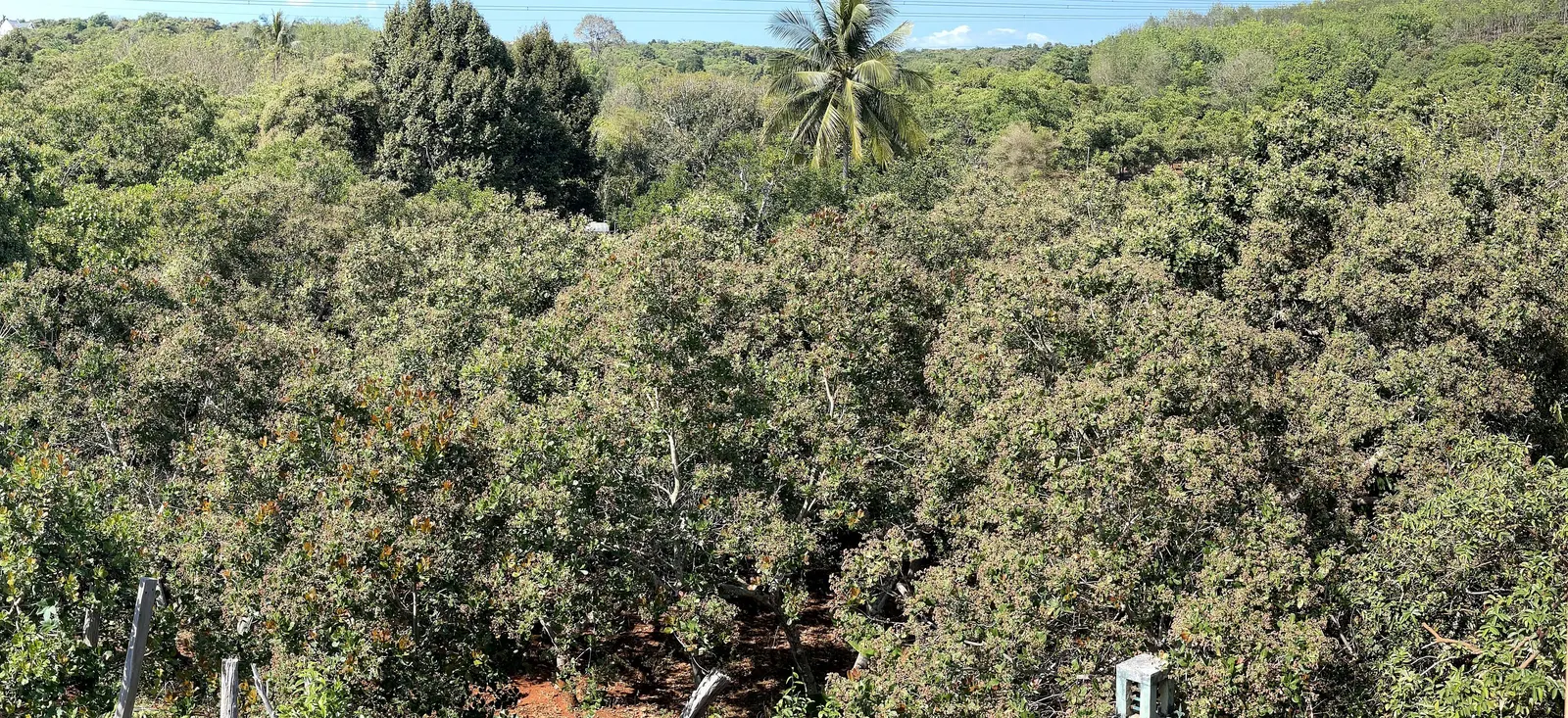
- “Vườn Điều trổ bông ở Bình Phước” by Windrain, via Wikimedia Commons, licensed CC BY-SA 4.0. Resized; converted to WebP.
Sources
- 1
Fruit and Tree Nuts Outlook: July 2026
Section “Lower Import Volumes Pressure U.S. Cashew Market”, pp. 26–27. Vietnam 89% of US shelled-cashew import volume in 2022–2024 (India and Brazil 80% in 2000–2002); 2025 imports 277.3 million lb. Shares are by volume under HS 0801.32 (printed as “8001.32” in the report). ERS calls the shell oil “urushiol”; the scientific sources name anacardic acid and cardol.
- 2
Statistics of main imports by month: December, 2025
Preliminary. Row 4 “Cashew nut”: 2025 year to date 2,941,858 t, US$4,491,821,290 (+17.7% volume, +39.3% value). The customs line does not split raw (in-shell) nuts from kernels; the ministry and trade press describe the imports as raw cashews.
- 3
Kew taxon page with the POWO data: Species Plantarum (1753); native range “Trinidad to S. Tropical America”; tree of the seasonally dry tropical biome, up to 10 m; cashew apple is the thickened pedicel.
- 4
Statistics of main exports by month: December, 2025
Preliminary. Row 3 “Cashew nut”: 2025 year to date 766,585 t, US$5,229,389,219 (+5.7% volume, +20.4% value on 2024).
- 5
Xuất khẩu điều tiếp tục “bùng nổ” vào đầu năm 2026
Citing the Ministry of Agriculture and Environment: 2025 imports of “more than 2.9 million tonnes of raw cashews (điều thô)” worth US$4.5 billion; top markets China, US, Netherlands.
- 6
Đông Nam bộ: Giá điều cao, nông dân thu hàng trăm triệu đồng lợi nhuận
Late March 2025 is the main harvest in the Southeast; the Southeast has over 192,000 ha of cashew, 61% of the national area.
- 7
[Niên giám Thống kê tỉnh Bình Phước 2024 (Bình Phước Statistical Yearbook 2024)]
Table 154, pp. 362–363: cashew planted area 148,239 ha, harvested area 145,043 ha, production 155,053 t in 2024 (preliminary); 2023: 149,647 ha and 195,257 t. Hosted by the Đồng Nai statistics office because Bình Phước merged into Đồng Nai on 1 July 2025.
- 8
The European market potential for cashew nuts
Product description, INC production figures for 2024/2025 (world 5.29 Mt raw nuts; Cambodia 800,000 t; Vietnam 340,000 t), harvest timing by hemisphere, sun-drying to 8–10% moisture, the five processing steps, and Vietnam’s 2024 share of imports in the UK (90%), the Netherlands (75%), Germany (62%), France (63%), Spain (61%) and Italy (49%).
- 9
Cashew harvest begins in Bình Phước Province
Harvest begins in the early days of the lunar new year; most nuts ripen in early March if the weather holds; Bình Phước has over 152,000 ha, “nearly 50 per cent of the country’s total area”; districts Bù Gia Mập, Bù Đăng, Phú Riềng, Đồng Phú.
- 10
Quy trình kỹ thuật thâm canh và ghép cải tạo vườn điều
Cashew is grown from Đà Nẵng southwards in three regions (Southeast, Central Highlands, South Central Coast); dry season of 4–6 months; first pruning right after harvest ends, in April–May (Southeast, Central Highlands) or June–July (South Central Coast); flowering in the January–April dry season.
- 11
Cashew exports surpass $5 billion for the first time
China overtook the US as the largest market in 2025; domestic raw nuts meet “only about 10 per cent” of processing demand (attributed to industry insiders); imports mainly from Africa and Cambodia.
- 12
Statistics of main exports by month: December, 2024
Preliminary. Row 3 “Cashew nut”: 2024 year to date 723,808 t, US$4,343,477,216. Later press figures for 2024 (about 730,000 t) differ; this is the customs preliminary.
- 13
Xuất khẩu điều lần đầu tiên vượt mốc 5 tỷ USD
Customs data for 2025: average export price US$6,822/t; China 172,700 t / US$1.115 billion; US 146,000 t / US$975.4 million (−24.1% volume, −15.5% value).
- 14
Xuất nhập khẩu điều vượt 5,6 tỷ USD nhưng nhập siêu 400 triệu USD
Citing the Customs Department: 2025 cashew import origins by volume — Cambodia 32.9% (also of value), Côte d’Ivoire 25.3%, Nigeria 9.7%, Ghana 8%.
- 15
Cashew firms propose to expand raw material areas
Citing the Ministry of Agriculture and Rural Development: 314,000 ha planted in 2023 (−8,300 ha on 2022), 300,000 ha harvested, over 345,000 t; VINACAS: domestic output meets about 12% of processing needs. Its 2023 import figure is not used (conflicts with customs).
- 16
[FAOSTAT Crops and livestock products: cashew nuts in shell, production quantity, 2024]
FAOSTAT returned a server error on 2026-10-07. Figures read from the table in Wikipedia “Cashew” (FAOSTAT accessed by its editors 7 June 2026): world 4,241,104 t; Côte d’Ivoire 944,673; India 794,910; Tanzania 528,262; Vietnam 306,185; Ghana 218,575. They match the shares USDA ERS gives in FTS-385 (22, 19, 12 and 7%).
- 17
Nghị quyết 202/2025/QH15 về việc sắp xếp đơn vị hành chính cấp tỉnh
Yên Bái merged into Lào Cai; Quảng Nam into Đà Nẵng city; Kon Tum into Quảng Ngãi; Bắc Kạn into Thái Nguyên; Bình Phước into Đồng Nai (point 17; checked against the hoatieu.vn copy of the text on 2026-10-07). In force 1 July 2025.
- 18
Ngành điều trước thách thức giữ vững “ngôi đầu bảng”
Reports Decision 431/QĐ-BNN-TT (26 January 2024): keep about 280,000–300,000 ha of cashew by 2030 (Southeast 170,000–180,000; Central Highlands 80,000–90,000; other provinces 10,000–30,000). The decision itself was not read.
- 19
Hạt điều Bình Phước được chứng nhận Chỉ dẫn địa lý
GI certificate announced 9 April 2018; covers raw cashew nuts, kernels and roasted salted cashews from Bình Phước; GI specification cites kernel recovery of not less than 30% by weight.
- 20
Small-scale cashew nut processing
Sections 1.2, 2.8, 3.2, 3.3: apple yield 8–10 times the weight of raw nuts; nut forms first, stalk then swells; harvest from the ground; apple keeps only 24 hours after picking; apple ripens before the nut; uses (juice, jam, wine in West Africa, feni in India). Its CNSL share is given as both 15% and 20–25% of the nut; not used for that figure. Health and vitamin statements in §3.3 are not used.
- 21
TCVN 4850:2010 Nhân hạt điều — Specification for Cashew kernels
Replaces TCVN 4850:1998. Definitions §3 (cashew apple as false fruit; CNSL main components anacardic acid and cardol), moisture ≤5% (§5.1.3), Table 2 grades W160–W500 with kernels per kg and per lb. Current validity not confirmed: the national standards register could not be read.
- 22
Specifications for Cashew Kernels
US trade specification, “Updated September 2023”. Count per kg / per lb for sizes 180, 210, 240, 320, 450; moisture 3–5%; quality classes; definitions of wholes, butts and splits.
- 23
Cashew Tree: Source for Nuts, “Apples,” Even Brake Linings
Family Anacardiaceae, shared with poison ivy, mango and pistachio; shell resin chemically similar to that of poison ivy; apple is the swollen flower/fruit stalk; shell chemicals used in brake linings.