Origin guide
Star Anise
The dried fruit of an evergreen tree from the hills on either side of the China–Vietnam border. This guide follows it from the tree to the export market.
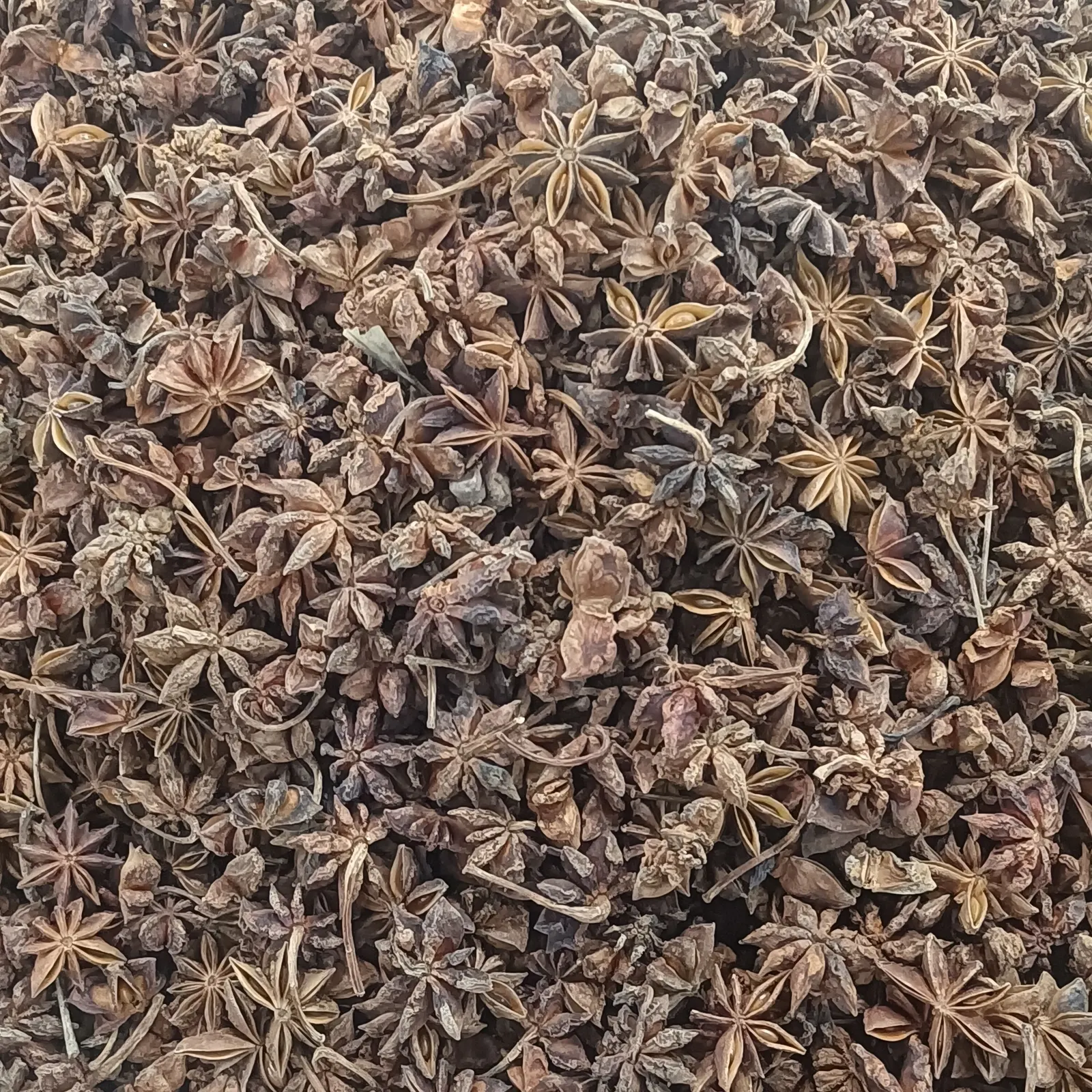

In short
Star anise is the dried, star-shaped fruit of Illicium verum, an evergreen tree native to southern China and northern Vietnam. China grows most of the world’s crop; Vietnam is the second-largest producer, and its star anise comes mainly from the border province of Lạng Sơn (Lang Son).
Quick facts
- Native range
- Southern and western Guangxi (China) to northern Vietnam1
- World production
- China about 80%; Vietnam second6Guangxi grew over 90% of China’s crop in 2018
- Grown in Vietnam
- Lạng Sơn, Cao Bằng, Quảng Ninh, Bắc Kạn2
- Harvests
- Main autumn crop roughly August–October; smaller spring crop roughly January/February–April7,8,3sources disagree by about a month
- Exports, 2025
- 14,307 tonnes, US$58.7 million9as reported by the Vietnam Pepper and Spice Association
- Largest markets, 2025
- India 9,896 t (about 70%) · United States 1,030 t9
- Geographical indication
- Lạng Sơn star anise, protected in Vietnam since 20078
Star anise is grown commercially in two neighbouring regions: Guangxi in southern China and the northern border provinces of Vietnam. Start with where star anise comes from — the growing regions, the two harvests, drying, grading and trade, with every figure dated and sourced. The guides below cover how it differs from other spices and look-alikes.
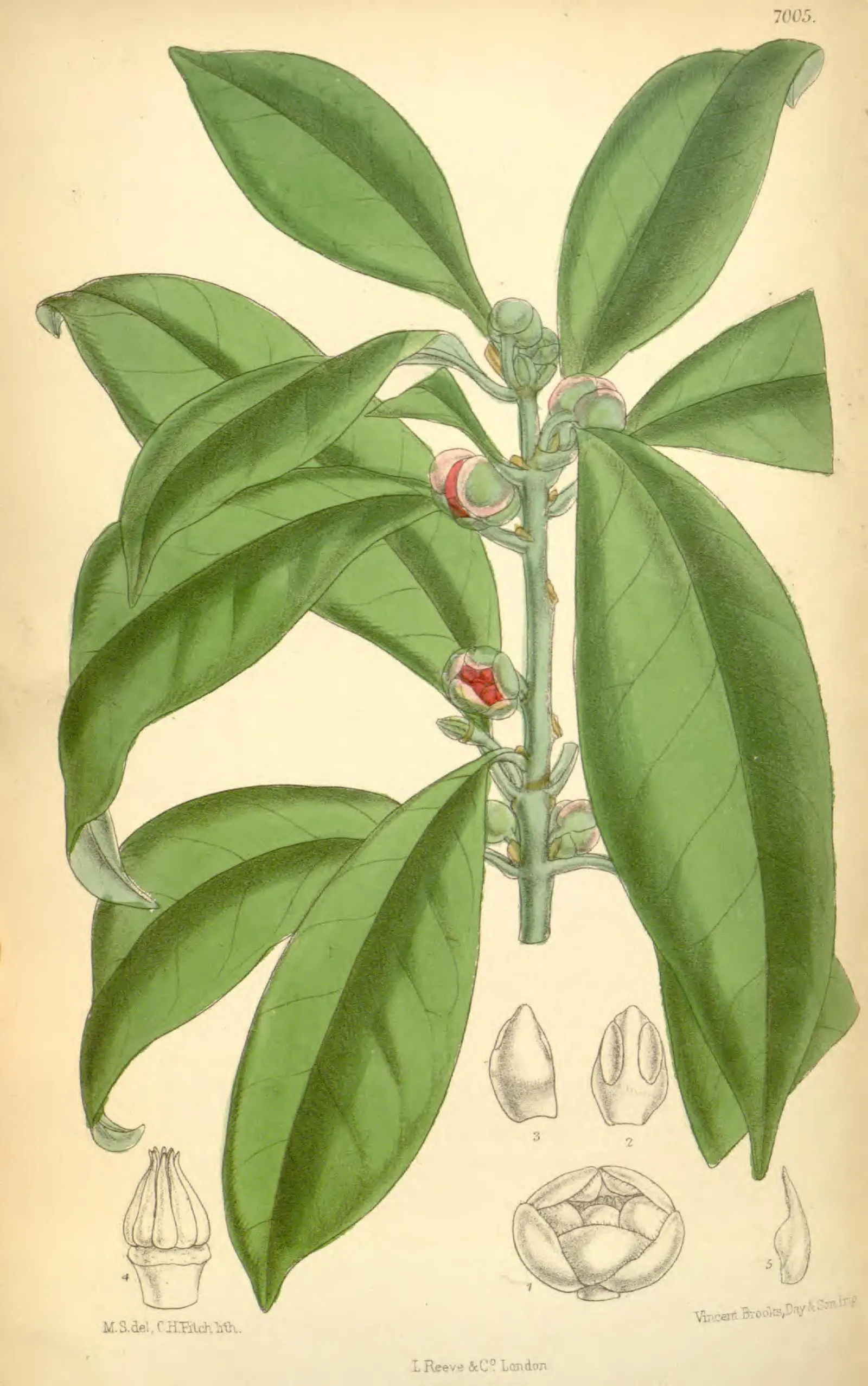
From tree to trade
Six steps take star anise from the tree to the export market. Each step links to the sources behind it.
- 01Place
Border provinces
Lạng Sơn, Cao Bằng, Quảng Ninh and Bắc Kạn, across the border from Guangxi.2
- 02Plant
An evergreen tree
Illicium verum grows 8–15 m tall and bears commercial fruit from roughly 7–10 years, for decades after.5,2
- 03Harvest
Picked green, twice a year
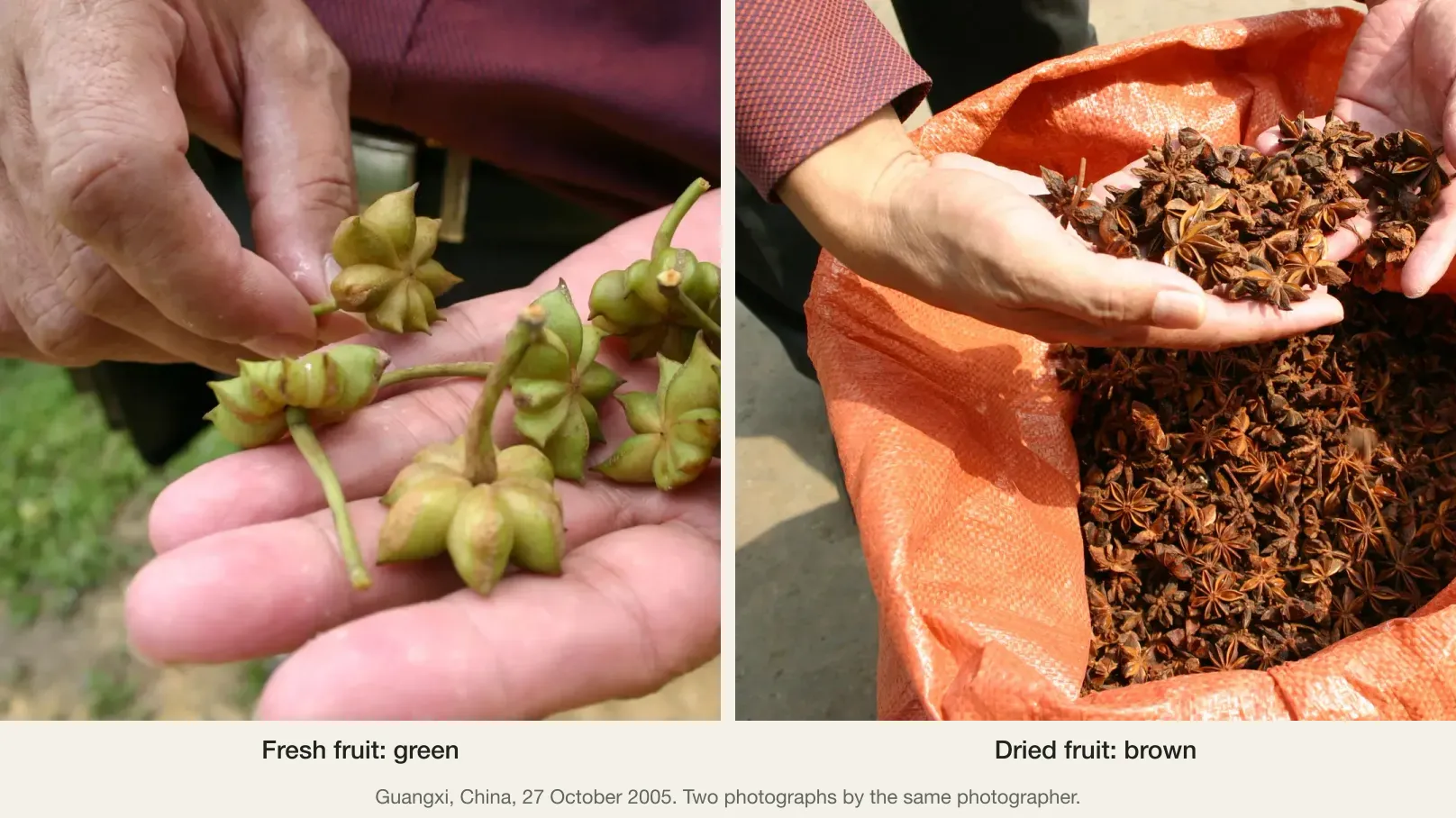
Fruit is picked green, before it splits, in a main autumn crop and a smaller spring crop.5,7
- 04Process
Dried to brown
Sun-and-cover drying or a sack kiln at 30–40 °C for 12–18 hours; 100 kg of fresh fruit gives 25–30 kg dried.10,3
- 05Grade
Whole stars and broken
ISO 11178 and Vietnam’s TCVN 8852 specify the product; offers distinguish autumn from spring crop and whole from broken.11,12,13
- 06Use & world
Spice and industry
The essential oil is mostly trans-anethole; the fruit is also a natural source of shikimic acid.4,14

Guides
- Where star anise comes from — Guangxi and Lạng Sơn, provinces and former districts, the autumn and spring crops, drying, ISO and TCVN grading, the Lạng Sơn geographical indication, and why production figures disagree.
- Star anise vs anise seed — two unrelated plants that share an aroma compound, compared species to species.
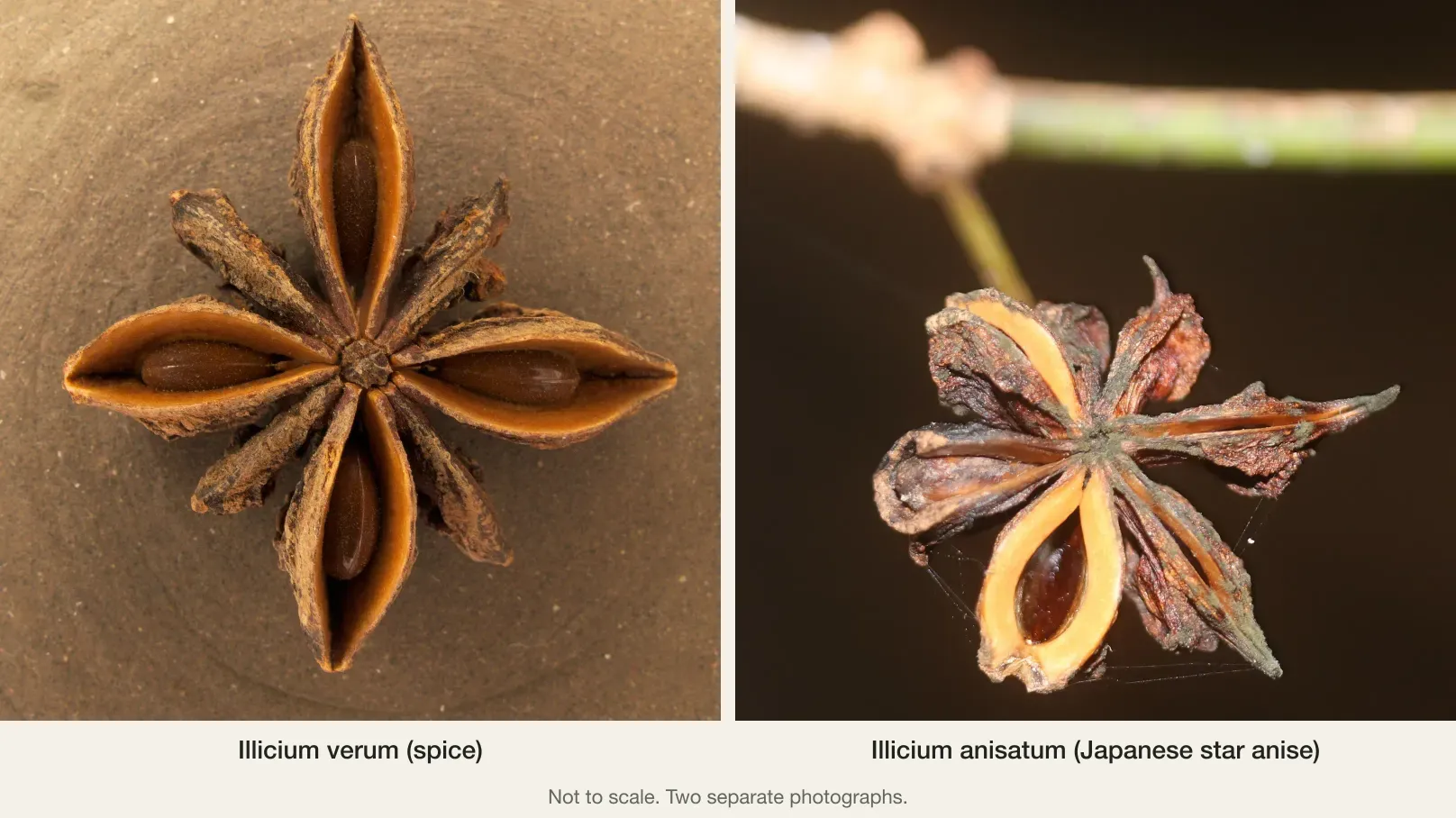
- Japanese vs Chinese star anise — how the toxic look-alike Illicium anisatum differs from the spice, why the dried fruits cannot be told apart by eye, which laboratory methods can, and what to ask a supplier.

Where it grows
In Vietnam, star anise grows in Lạng Sơn, Cao Bằng, Quảng Ninh and former Bắc Kạn, now part of Thái Nguyên.2,15 Lạng Sơn is the centre of the crop: see the Lạng Sơn region page for the province on the map and its sourced facts.
Image credits
- “Star anise ~ Illicium verum” by Fumikas Sagisavas, via Wikimedia Commons, licensed CC0. Resized; converted to WebP.
- “Curtis's botanical magazine. (IA mobot31753002721899).pdf, page 101” by M.S. (Matilda Smith), del.; C.H. Fitch, lith.; Curtis’s Botanical Magazine vol. 114, L. Reeve & Co., London, via Wikimedia Commons, licensed Public domain. Page 101 of the scanned volume extracted; resized; converted to WebP.
- “Fresh vs dried star anise, Guangxi (composite)” by fuzheado, via Wikimedia Commons, licensed CC BY-SA 2.0. Combined from “Guangxi - star anise farm in china 2005” and “Guangxi - star anise farm in china 2005 6782” by fuzheado, both CC BY-SA 2.0 on Wikimedia Commons; cropped to square panels and labelled. This combined image is licensed CC BY-SA 2.0.
- “Japanese star anise vs Chinese star anise (composite)” by Bff; Alpsdake, via Wikimedia Commons, licensed CC BY-SA 4.0. Combined from “Illicium verum20170511 7549” by Bff and “Illicium anisatum (fruits s10)” by Alpsdake, both CC BY-SA 4.0 on Wikimedia Commons; cropped to square panels and labelled. This combined image is licensed CC BY-SA 4.0.
Sources
- 1
Native range “China (S. & W. Guangxi) to N. Vietnam”, read from a search excerpt; the page blocks automated access.
- 2
[Star anise production and trade in Lạng Sơn (Sáng & Nguyệt 2021)]
Four growing provinces; Lạng Sơn area and output 2017–2020 and district shares (from the Lạng Sơn Statistics Office). Does not say whether tonnes are fresh or dried.
- 3
Botany, cultivation, fresh-to-dry ratio, oil composition, China and Vietnam as the main producers. Production figures in this 1999 text are historical and not used as current.
- 4
Quotes Ph. Eur. 11.0 for star anise fruit (≥ 70 mL/kg oil, ≥ 86.0% trans-anethole); GC–MS analysis of seven recent batches, all originating from China (Table 3), and GC-FID analysis of four batches against the specification (Table 2); “often used as a cheaper substitute for anise fruit”.
- 5
Illicium verum — Agroforestree Database 4.0
Tree size, fruit structure, flowering age, yields, ecology, biological fruiting cycle.
- 6
[Review of Illicium verum (Zou et al., Molecules 2023)]
China about 80% of world output; Guangxi over 90% of China’s output in 2018; Vietnam second.
- 7
Sức vươn xa của loài hoa tám cánh ở xứ Lạng
Văn Quan area and harvest months. Publication date not shown on the page.
- 8
Hoa hồi — sản vật đặc trưng của xứ Lạng
Domestic geographical-indication protection in 2007; harvest timing in lunar months. Promotional claims about quality are not used.
- 9
Exports of star anise to Thailand have surged
2025 exports by volume, value and market.
- 10
[Colour treatment of star anise fruit in Lạng Sơn (Dưỡng & Phương 2014)]
Three traditional colour-treatment methods; samples picked in September in Văn Quan.
- 11
ISO 11178:1995 Star anise (Illicium verum Hook. f.) — Specification
Reviewed and confirmed in 2024. Numeric limits not read (paid text).
- 12
TCVN 8852:2011 Hoa đại hồi (Illicium verum Hook. f.)
Scope and definition read; the table of physico-chemical limits is behind a paywall and not reproduced.
- 13
[Vietnamese star anise export listings (Tridge, freshdi)]
Seller claims: autumn crop larger and better coloured than spring crop; one seller’s specification. Shown only as what sellers state.
- 14
[Shikimic acid supply for oseltamivir (Washam, EHP 2006)]
Roche’s move from extracting shikimic acid from star anise to E. coli fermentation.
- 15
Nghị quyết 202/2025/QH15 về việc sắp xếp đơn vị hành chính cấp tỉnh
Yên Bái merged into Lào Cai; Quảng Nam into Đà Nẵng city; Kon Tum into Quảng Ngãi; Bắc Kạn into Thái Nguyên; Bình Phước into Đồng Nai (point 17; checked against the hoatieu.vn copy of the text on 2026-10-07). In force 1 July 2025.