Region
Lạng Sơn
Vietnam’s largest star anise province
Most of Vietnam’s star anise comes from this northern province. Here is where in Lạng Sơn it grows, when it is picked, how it is dried, and where the published figures stop agreeing.

Products from this region
- Star aniseIllicium verum
Vietnam’s largest star anise province; Lạng Sơn star anise has been a protected geographical indication since 2007.1,2,3
Why Lạng Sơn matters for star anise
Lạng Sơn (Lang Son) is the Vietnamese province with the largest star anise area and output.2,1 A 2021 forestry study names four provinces that grow the crop — Lạng Sơn, Cao Bằng, Quảng Ninh and Bắc Kạn — and puts Lạng Sơn at about 60% of the national star anise area.1 A 2026 press report puts its share of national output higher, at about 87.5%.4 Vietnam as a whole is the world’s second-largest producer, after China.5
The tree, Illicium verum, is native to an area running from southern and western Guangxi in China to northern Vietnam.6 Lạng Sơn star anise has been a protected geographical indication in Vietnam since 2007.3 Unlike Bắc Kạn, Lạng Sơn was not merged into another province in the July 2025 reorganisation.7
How much star anise does Lạng Sơn grow?
There is no single answer. Published figures for the province’s planted area run from about 30,600 to 40,000 hectares, depending on the source and the year: 30,647 ha in 2020 from the provincial statistics office,1 more than 35,000 ha in a 2022 government article,3 33,738 ha in 20238 and about 40,000 ha in a 2026 press report.4
Planted area is not harvested area. In 2020, 24,886 of the 30,647 planted hectares were harvested.1 Output also swings from year to year: the same statistics give 13,521 tonnes in 2017, 8,419 t in 2018, 14,390 t in 2019 and 14,503 t in 2020, without saying whether these are fresh or dried tonnes.1 Treat any single figure as an estimate for a given year. The national figures, and why they disagree, are set out in where star anise comes from.
In Lạng Sơn, trees give a first harvest after 7–10 years and can keep producing for a very long time — sometimes as long as 100 years, according to the 2021 study.1
Where in Lạng Sơn star anise grows
Five former districts account for most of the province’s production.1 District names are those the sources use; Vietnam’s district level was abolished in the 2025 reorganisation.9
| Former district | Share of production |
|---|---|
| Văn Quan | 32% |
| Bình Gia | 25% |
| Cao Lộc | 11% |
| Tràng Định | 8% |
| Văn Lãng | 8% |
| Other | 16% |
Source: Lạng Sơn Statistics Office, as reproduced by Sáng and Nguyệt (2021).1 For Văn Quan alone, a business magazine gives about 15,000 ha — roughly half the province’s area — and yields of 2–2.5 tonnes of fresh fruit per hectare.10
When star anise is harvested in Lạng Sơn
There are two crops a year: a main autumn crop and a smaller spring crop. Each row below is one source.
| Source | Jan | Feb | Mar | Apr | May | Jun | Jul | Aug | Sep | Oct | Nov | Dec |
|---|---|---|---|---|---|---|---|---|---|---|---|---|
| Main (autumn) crop, Văn Quan10Aug–Oct | in season | in season | in season | |||||||||
| Spring crop, Văn Quan10Jan–Mar | in season | in season | in season | |||||||||
| Research samples picked, Văn Quan11Sep · a sampling month, not a season | in season |
The Ministry of Industry and Trade gives the seasons in lunar months instead: the main crop in the 8th lunar month and the spring crop in the 4th, each lasting three to four months.3 Lunar months do not map onto fixed Gregorian months, so that source is not drawn on the chart.
How Lạng Sơn star anise is dried
The fruit is picked green, before it splits,12 and has to be turned brown. A 2014 study, using fruit picked in Văn Quan, describes three traditional treatments:11
- Blanching in boiling water. It gives a good red-brown colour but takes a lot of labour, and is now largely abandoned.
- Sun and cover. Fruit is spread on a yard or tarpaulin in the morning sun, covered with white plastic sheeting after 5–6 hours, and turns yellow-brown 4–5 hours later. It depends on the weather.
- Sack kiln. Fruit in sacks is stacked on wooden racks over a charcoal or wood fire, covered, and held at 30–40 °C for 12–18 hours. It takes less labour and handles 1–3 tonnes of fresh fruit a batch, and is the most common method; its drawbacks are uneven colour and a risk of smoke taint.
By weight, 100 kg of fresh fruit gives 25–30 kg dried.13
Lạng Sơn star anise as a geographical indication
Vietnam protected the name Lạng Sơn for star anise as a geographical indication in 2007.3 In 2014 the European Commission published a list of Vietnamese geographical indications for consultation during free-trade negotiations; it includes “Lạng Sơn — Star aniseed”.14 Vietnamese government sources report that the name is now protected in the EU under the EU–Vietnam Free Trade Agreement.8
Where Lạng Sơn star anise goes
The 2021 study names China and Europe as the two largest export markets for Lạng Sơn star anise.1 National export statistics are reported for Vietnam, not by province: in 2025 the country exported 14,307 tonnes worth US$58.7 million, about 70% of it to India, as reported by the Vietnam Pepper and Spice Association.15 The two sources measure different things in different years, so they do not contradict each other. Grades, standards and the full export picture are in where star anise comes from and the star anise guide.
Image credits
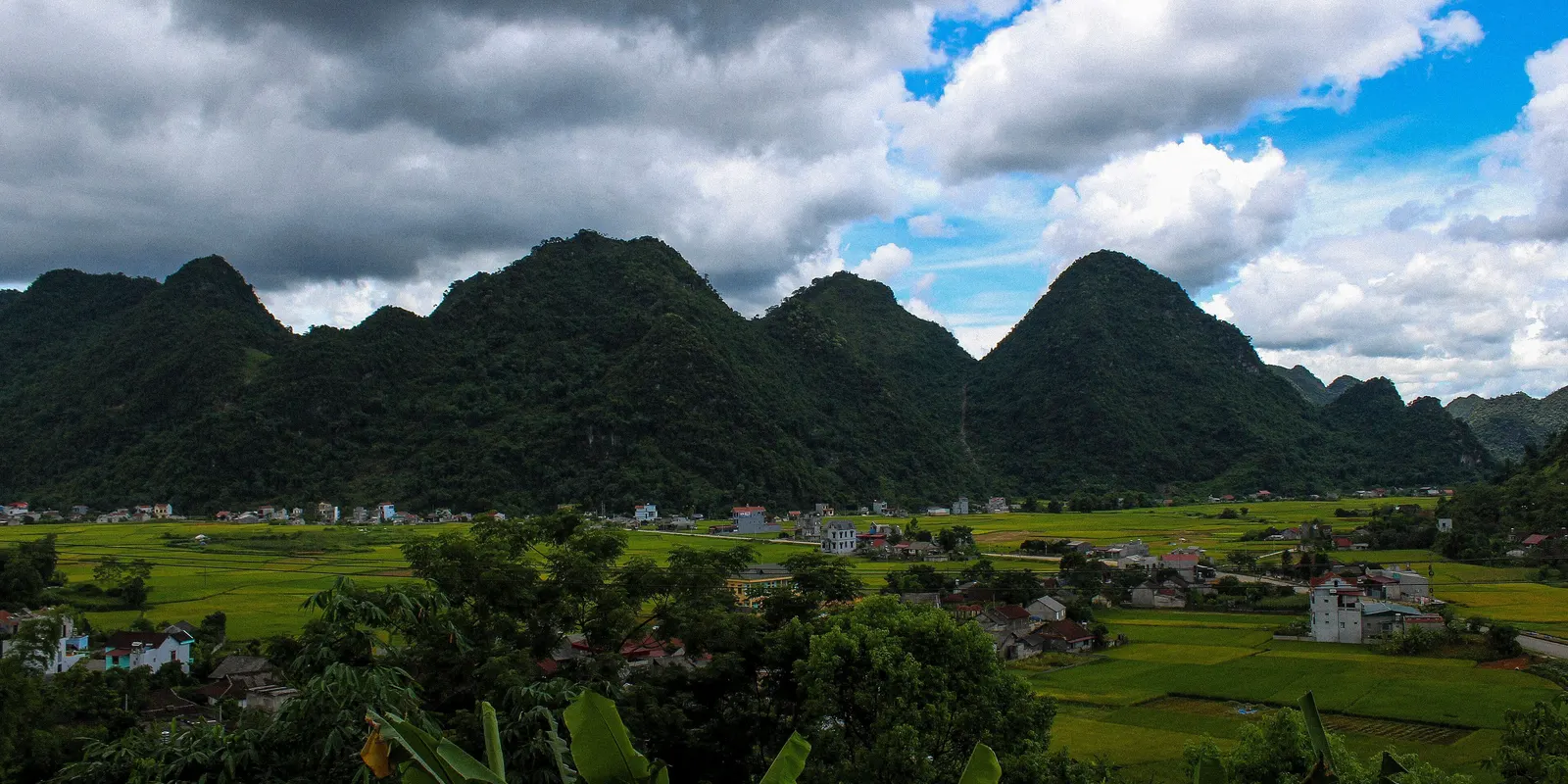
- “Thị trấn Bình Gia” by Hứa Chí Thân, via Wikimedia Commons, licensed CC BY-SA 4.0. Cropped and resized; converted to WebP.
Sources
- 1
[Star anise production and trade in Lạng Sơn (Sáng & Nguyệt 2021)]
Four growing provinces; Lạng Sơn area and output 2017–2020 and district shares (from the Lạng Sơn Statistics Office). Does not say whether tonnes are fresh or dried.
- 2
Lang Son grows anise in the organic direction for export
Lạng Sơn as the province with the largest star anise area and output.
- 3
Hoa hồi — sản vật đặc trưng của xứ Lạng
Domestic geographical-indication protection in 2007; harvest timing in lunar months. Promotional claims about quality are not used.
- 4
[Star anise production and exports in Vietnam and China (DTiNews)]
National and provincial areas, output, Lạng Sơn share, China output and January–May 2026 exports. The paper does not give its own sources for the production estimates.
- 5
[Review of Illicium verum (Zou et al., Molecules 2023)]
China about 80% of world output; Guangxi over 90% of China’s output in 2018; Vietnam second.
- 6
Native range “China (S. & W. Guangxi) to N. Vietnam”, read from a search excerpt; the page blocks automated access.
- 7
Nghị quyết 202/2025/QH15 về việc sắp xếp đơn vị hành chính cấp tỉnh
Yên Bái merged into Lào Cai; Quảng Nam into Đà Nẵng city; Kon Tum into Quảng Ngãi; Bắc Kạn into Thái Nguyên; Bình Phước into Đồng Nai (point 17; checked against the hoatieu.vn copy of the text on 2026-10-07). In force 1 July 2025.
- 8
Tìm kiếm thị trường mới để cây hồi Lạng Sơn phát triển bền vững
Lạng Sơn area for 2023; EU protection under EVFTA.
- 9
- 10
Sức vươn xa của loài hoa tám cánh ở xứ Lạng
Văn Quan area and harvest months. Publication date not shown on the page.
- 11
[Colour treatment of star anise fruit in Lạng Sơn (Dưỡng & Phương 2014)]
Three traditional colour-treatment methods; samples picked in September in Văn Quan.
- 12
Illicium verum — Agroforestree Database 4.0
Tree size, fruit structure, flowering age, yields, ecology, biological fruiting cycle.
- 13
Botany, cultivation, fresh-to-dry ratio, oil composition, China and Vietnam as the main producers. Production figures in this 1999 text are historical and not used as current.
- 14
Publication of geographical indications from Vietnam for consultation (2014/C 274/08)
Lists “Lạng Sơn — Star aniseed”.
- 15
Exports of star anise to Thailand have surged
2025 exports by volume, value and market.