Origin
Where Does Star Anise Come From?
Almost all of it grows in two neighbouring regions: Guangxi in China and the northern border provinces of Vietnam. Here is where, when it is picked, how it is dried and graded, and why the production figures disagree.
Quick answer
Southern China and northeast Vietnam. Star anise is the dried fruit of Illicium verum, an evergreen tree native to Guangxi and northern Vietnam. China grows about 80% of the world’s crop, over 90% of that in Guangxi (2018); Vietnam is the second-largest producer, and most of its crop comes from Lạng Sơn (Lang Son). The fruit is picked green in a main autumn harvest and a smaller spring one, then dried to brown.
Star anise comes from the dried, star-shaped fruit of Illicium verum, an evergreen tree native to southern China — mainly Guangxi — and northeast Vietnam.1 China grows about 80% of the world’s supply and Vietnam is the second-largest producer,2 with most Vietnamese star anise coming from the border province of Lạng Sơn (Lang Son).3 The sections below go further than that one line: provinces and former districts, the two harvests, drying, grading, the geographical indication, and sourced export figures.
Star anise grows in two neighbouring regions
Most commercial star anise comes from two producing areas that meet at the China–Vietnam border. Every figure below carries its year and source, because the sources do not agree (see why the numbers disagree).
| Country | Main growing areas | Share or output (year, source) | Notes |
|---|---|---|---|
| China | Guangxi, in the south | About 80% of world output; Guangxi grew over 90% of China’s crop in 20182 · 90,000–95,000 t a year, per Vietnamese trade press (2026)4 | The press figure gives no source of its own |
| Vietnam | Lạng Sơn, Cao Bằng, Quảng Ninh and former Bắc Kạn3 | About 22,000 t a year (2026)4; other estimates from about 16,000 t a year (2024)5 | Second-largest producer2 |
Three of Vietnam’s four star anise provinces — Lạng Sơn, Cao Bằng and Quảng Ninh — lie on the border with Guangxi. In practice the two producing regions are one belt of hill country divided by a frontier, which is why the same species is grown on both sides.
Where is star anise native to?
Kew’s Plants of the World Online gives the native range as “China (S. & W. Guangxi) to N. Vietnam”.1 Older accounts draw it more widely: PROSEA (1999) places its origin in south-eastern China (Guangxi, Guangdong, Fujian, Guizhou and Yunnan) and northern Indo-China (Laos, Vietnam), and notes that the tree is known only in cultivation.6 The ICRAF tree database lists China and Vietnam as native and Jamaica, Laos and the Philippines as places it has been introduced.7
Where star anise grows in Vietnam
Where is star anise grown in Vietnam? A 2021 study names four provinces — Lạng Sơn, Cao Bằng, Bắc Kạn and Quảng Ninh — with a combined area of about 50,000 ha.3 Lạng Sơn is by far the largest.
Lạng Sơn. Its star anise area is reported at about 30,000–43,000 ha depending on source and year: 30,647 ha in 2020,3 more than 35,000 ha in 2022,8 33,738 ha9 and more than 43,370 ha10 in two 2023 reports, and 40,000 ha in 2026.4
Within the province, production is concentrated in a few former districts. The breakdown below is from the Lạng Sơn Statistics Office, as published in the 2021 study.3 Văn Quan alone is reported to have about 15,000 ha, roughly half the province’s star anise.11
| Former district | Share of Lạng Sơn star anise production |
|---|---|
| Văn Quan | 32% |
| Bình Gia | 25% |
| Cao Lộc | 11% |
| Tràng Định | 8% |
| Văn Lãng | 8% |
| Other | 16% |
Quảng Ninh and Cao Bằng. Quảng Ninh is reported at about 8,600 ha and Cao Bằng at about 4,500 ha (2026).4
Bắc Kạn. Star anise is grown there,3 but none of the sources we could verify publishes its area, so we give none.
The tree behind the spice
Illicium verum is an evergreen tree of the family Schisandraceae.6,14 It grows 8–15 m tall, occasionally 20 m, with a trunk up to 30 cm across.7 The fruit is a star of 6–8 boat-shaped follicles, rarely up to 12–13, each holding one seed.7
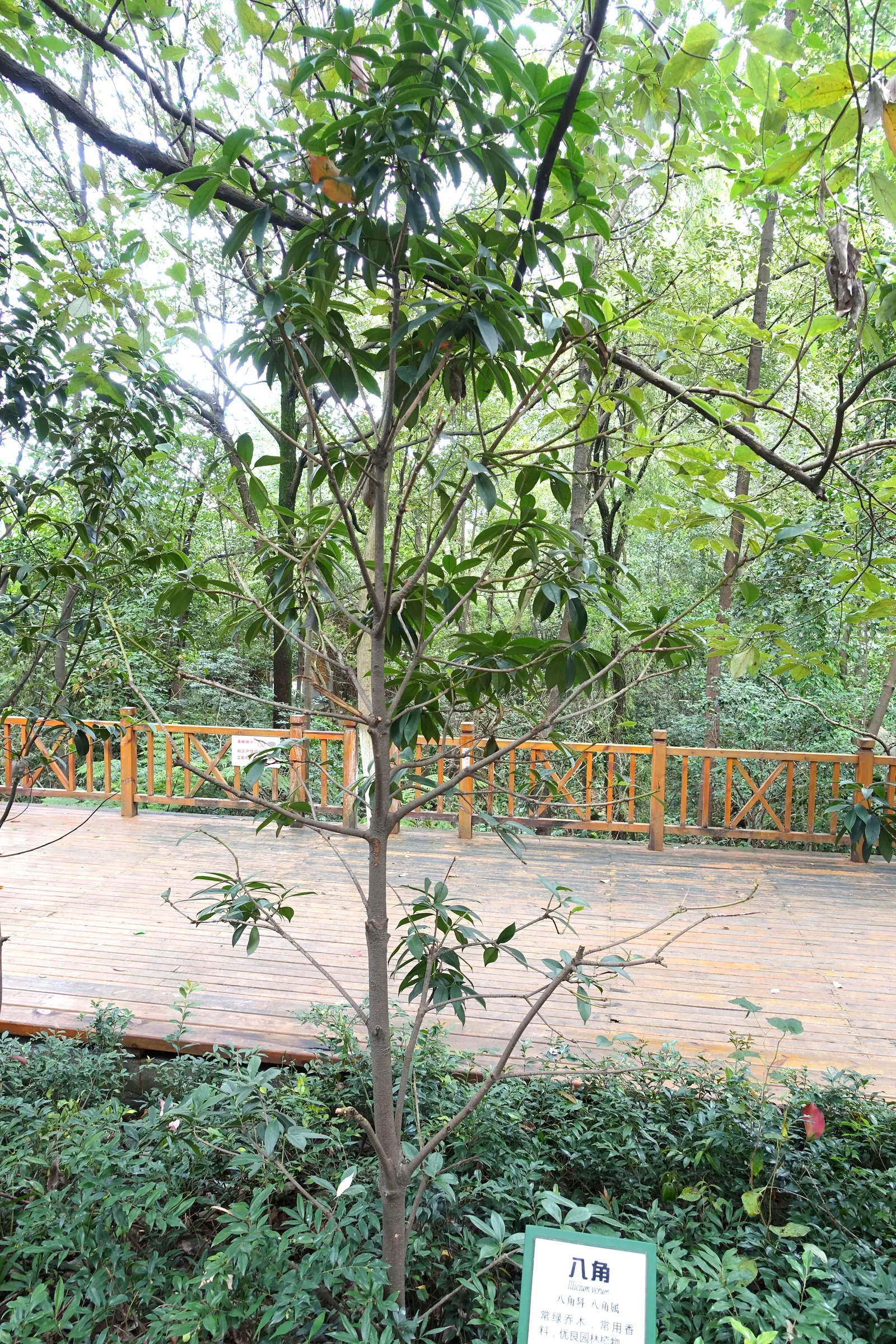

How does star anise grow as a crop? It is a long-lived plantation tree. It starts flowering at 5–6 years, bears seed from 9–10 years and can continue for about 80 years.7 In Lạng Sơn, trees are harvested from 7–10 years after planting, sometimes for as long as 100 years.3
Yields vary with age. ICRAF gives 8–12 kg of fresh fruit per mature tree per season;7 PROSEA gives 5–10 kg for trees aged 13–25 years and 10–20 kg for older trees.6
Commercial star anise cultivation needs acid soil. ICRAF describes feralitic soils of pH 4–6, not limestone, with 1,500–2,400 mm of rain a year, at elevations up to about 2,000 m.7
From the tree onwards, the chain looks like this.
- 01Place
Border provinces
Lạng Sơn, Cao Bằng, Quảng Ninh and Bắc Kạn, across the border from Guangxi.3
- 02Plant
An evergreen tree
Illicium verum grows 8–15 m tall and bears commercial fruit from roughly 7–10 years, for decades after.7,3
- 03Harvest
Picked green, twice a year
Fruit is picked green, before it splits, in a main autumn crop and a smaller spring crop.7,11
- 04Process
Dried to brown
Sun-and-cover drying or a sack kiln at 30–40 °C for 12–18 hours; 100 kg of fresh fruit gives 25–30 kg dried.15,6
- 05Grade
Whole stars and broken
ISO 11178 and Vietnam’s TCVN 8852 specify the product; offers distinguish autumn from spring crop and whole from broken.16,17,18
- 06Use & world
Spice and industry
The essential oil is mostly trans-anethole; the fruit is also a natural source of shikimic acid.14,19
Two harvests a year: the autumn crop and the spring crop
The tree flowers and fruits twice a year,7 so the trade has two crops. Each row below is one source’s statement; they disagree by about a month.
| Source | Jan | Feb | Mar | Apr | May | Jun | Jul | Aug | Sep | Oct | Nov | Dec |
|---|---|---|---|---|---|---|---|---|---|---|---|---|
| VnBusiness, Văn Quan (undated, 2025 or later)11Aug–Oct, Jan–Mar · autumn crop Aug–Oct; spring crop Jan–Mar | in season | in season | in season | in season | in season | in season | ||||||
| Exporter listings (seller claims)18Sep–Oct, Mar–Apr · autumn crop early Sep–late Oct; spring crop Mar–late Apr | in season | in season | in season | in season | ||||||||
| CMB News price report, 202620Aug–Sep (approximate) · main harvest late Aug–Sep only | in season | in season | ||||||||||
| PROSEA (1999)6Aug–Sep · main harvest “usually in August–September” | in season | in season | ||||||||||
| Dưỡng & Phương (2014)15Sep · research samples picked in September, Văn Quan | in season | |||||||||||
| ICRAF (2009)7Oct–Nov, May–Jun · fruit ripening, a biological cycle, not a trading calendar | in season | in season | in season | in season | ||||||||
| Our reading of the rows above11,18,6Aug–Oct, Feb–Apr (approximate) · main crop Aug–Oct; spring crop Jan/Feb–Apr | in season | in season | in season | in season | in season | in season |
The main (autumn) crop runs roughly August–October; the smaller spring crop roughly January/February–April. The months shift by locality and year, and the sources disagree by about a month.11,18,8 Exporters describe the autumn crop as giving more fruit, with larger, better-coloured stars than the spring crop; that is a seller’s description, not a measurement.18
Output also swings from year to year. Lạng Sơn produced 13,521 t in 2017 but only 8,419 t in 2018, before recovering to 14,390 t in 2019.3
From green fruit to brown star: how star anise is dried
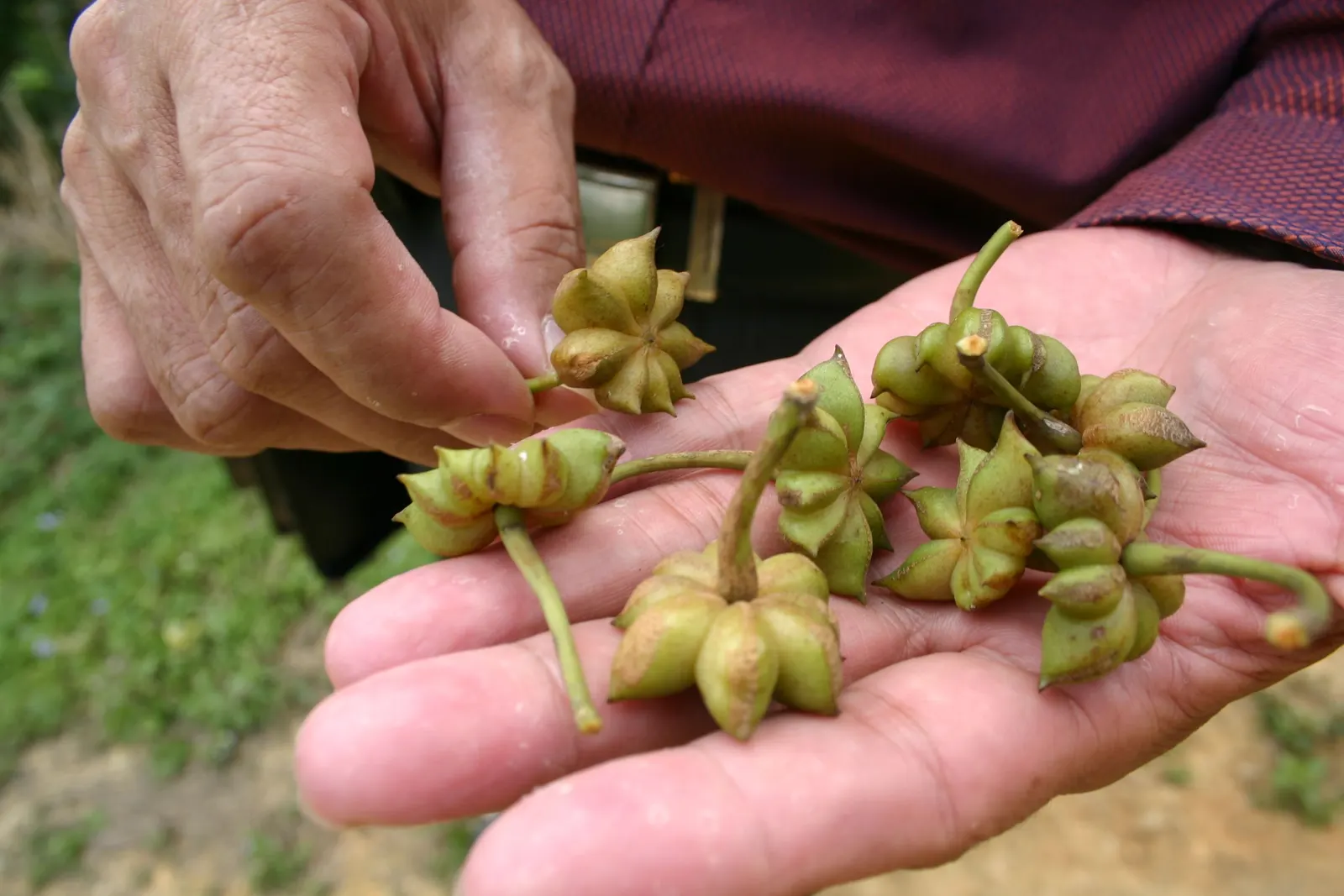

Star anise is picked green, just before it ripens and before the follicles split open.7,21 Drying turns the green fruit brown. A 2014 forestry study describes three traditional methods used in Lạng Sơn and Quảng Ninh:15
- Blanching. The fruit is dipped in boiling water before drying. It gives an attractive red-brown colour but takes a lot of labour, and has almost disappeared.
- Sun-and-cover. The fruit is spread on a yard or tarpaulin in the morning sun; after 5–6 hours it is covered with white plastic sheeting, and 4–5 hours later it has turned yellow-brown. It depends on the weather.
- Sack kiln. Sacks of fruit are stacked on a wooden rack over a charcoal or wood fire and covered with a tarpaulin, at 30–40 °C for 12–18 hours. It needs less labour and handles 1–3 t of fresh fruit per batch, so it is the common method; the drawbacks are uneven colour and a risk of smoke taint.
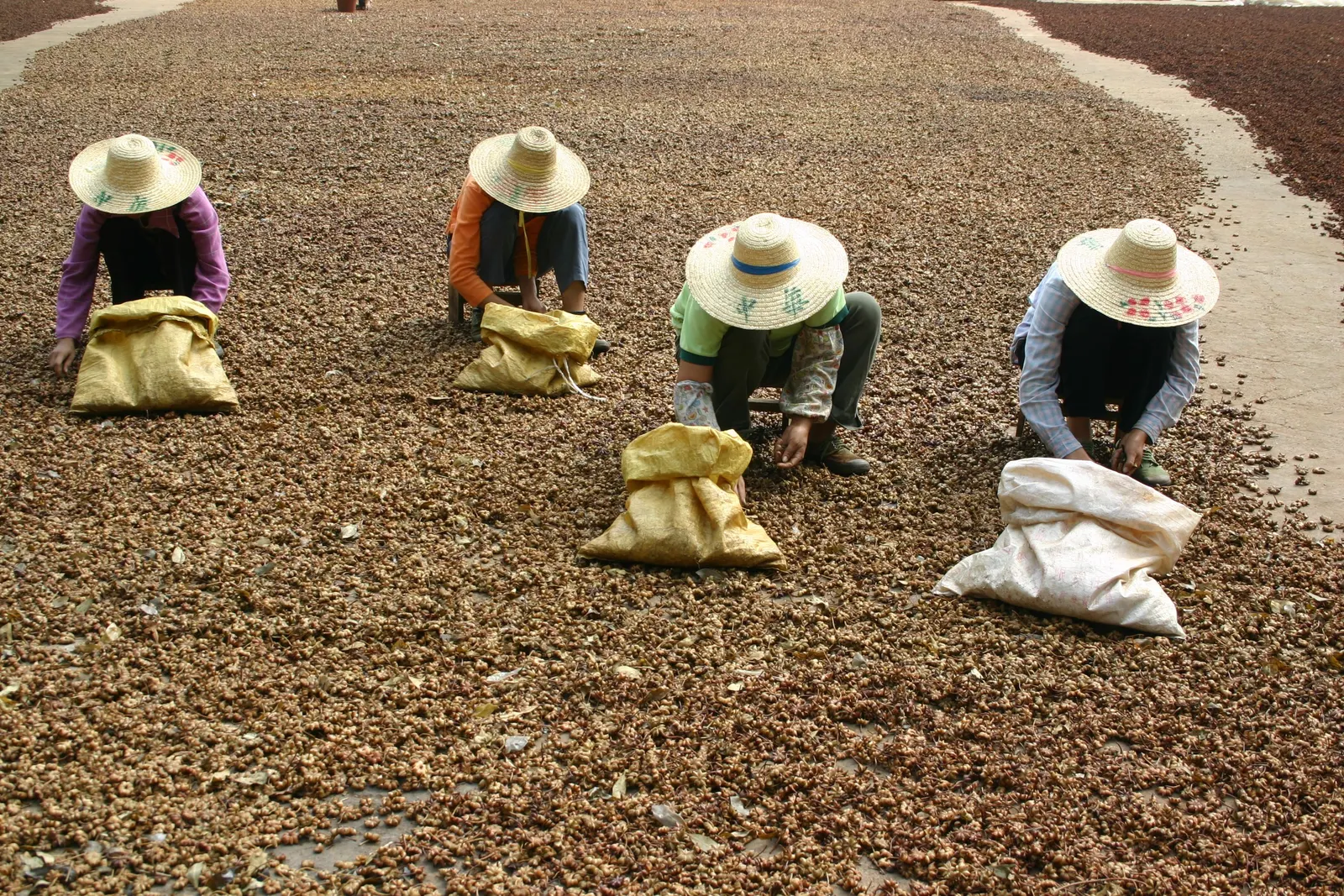

Some growers have invested in steam dryers. One Lạng Sơn grower quoted in the national press said a steam dryer raised her capacity more than tenfold compared with manual drying — one family’s account, not a measured average.10
Drying removes most of the weight. PROSEA gives 25–30 kg of dried fruit from 100 kg fresh, after about ten days of sun drying;6 ICRAF gives about 1 kg dried from 4–5 kg fresh.7 That ratio of roughly four to one matters when reading production figures.
The dried fruit contains 5–8% essential oil, of which anethole makes up 85–90%; about 10 kg of dried fruit yields 1 kg of oil.7 Other sources report trans-anethole at 70–93%6 and above 80%2 of the oil.
How star anise is graded and traded
Two published standards cover the dried fruit. ISO 11178:1995, Star anise (Illicium verum Hook. f.) — Specification, sets requirements for the dried fruit and was reviewed and confirmed in 2024.16 TCVN 8852:2011, Vietnam’s national standard Hoa đại hồi, applies to whole and broken dried star anise.17 Their numeric limits are in paid texts we have not read, so this page does not quote them.
Export offers use their own vocabulary, not defined by a single standard. Sellers distinguish the autumn crop from the spring crop and whole stars from broken ones.18
One Vietnamese exporter’s listing, for example, states: moisture at most 13.5%, admixture at most 1%, broken stars at most 8%, ash at most 9%, and stars at least 2 cm across.18 That is a single seller’s specification, shown to illustrate what an offer looks like — not a standard and not a recommendation.
Lạng Sơn star anise: a protected geographical indication
Lạng Sơn star anise has been a protected geographical indication in Vietnam since 2007.8 The protected name covers both the fruit and its essential oil: “Quả hồi và tinh dầu hồi Lạng Sơn”.10
Geographical indicationGI
A protected name that ties a product to a delimited place of production. For a buyer, “Lạng Sơn” on a protected product means it comes from the defined Lạng Sơn growing area, not simply from Vietnam.
In 2014 the European Commission published a list of Vietnamese geographical indications for consultation during free-trade negotiations; it includes “Lạng Sơn — Star aniseed”.22 According to Vietnamese government and press sources, Lạng Sơn star anise has been protected in the EU since 2020 under the EU–Vietnam Free Trade Agreement, as one of 39 Vietnamese geographical indications.9,10 We have not found the certificate number and do not print one.
How much star anise does Vietnam produce? Why the numbers disagree
There is no single answer. Each row below is one source’s figure, with the year it refers to.
| Indicator | Value | Year | Source |
|---|---|---|---|
| Vietnam, area | About 50,000 ha (four provinces) | 2021 or earlier | Sáng & Nguyệt3 |
| Vietnam, area | About 40,000 ha | 2024 | Vietnam Pepper Association5 |
| Vietnam, area | About 55,000 ha | 2026 | DTiNews4 |
| Vietnam, output | More than 2,000 t a year | Before 1999 (historical) | PROSEA6 |
| Vietnam, output | More than 16,000 t a year | 2024 | Vietnam Pepper Association5 |
| Vietnam, output | About 22,000 t a year | 2026 | DTiNews4 |
| Lạng Sơn, planted area | 30,647 ha | 2020 | Sáng & Nguyệt3 |
| Lạng Sơn, area | 33,738 ha · more than 43,370 ha | 2023 | MOIT9 · Nhân Dân10 |
| Lạng Sơn, share | About 70% of national area | 2023 | Nhân Dân10 |
| Lạng Sơn, share | About 87.5% of national output | 2026 | DTiNews4 |
| Lạng Sơn, output | 13,521 · 8,419 · 14,390 · 14,503 t (fresh or dried not stated) | 2017–2020 | Sáng & Nguyệt3 |
| Lạng Sơn, dried output | 7,500–16,000 t a year | 2023 | Nhân Dân10 |
| Lạng Sơn, dried output | 12,000–14,000 t a year | 2026 | CMB News20 |
| China, output | 90,000–95,000 t a year | 2026 | DTiNews4 |
Three things probably explain most of the spread. These are our explanations, not findings of the sources.
- Planted area is not harvested area. In 2020 Lạng Sơn had 30,647 ha planted but 24,886 ha harvested;3 young trees take 7–10 years to bear.
- Fresh and dried tonnes get mixed. Fresh fruit dries down roughly four to one.6,7 A figure of 18,000–20,000 t a year quoted for Văn Quan alone11 only makes sense as fresh fruit, since the same article gives yields of 2–2.5 t of fresh fruit per hectare.
- Harvests swing. Lạng Sơn’s output fell from 13,521 t to 8,419 t between 2017 and 2018.3
Treat any single figure as an estimate for a given year.
Who buys Vietnamese star anise
Export figures come from a single trade body, which makes them easier to compare across years than production estimates. The Vietnam Pepper and Spice Association (VPSA), which also reports Vietnam’s cinnamon exports,23 gives these numbers for star anise.
| Period | Volume | Value | Main markets |
|---|---|---|---|
| 2025 (full year) | 14,307 t (+2.2% on 2024) | US$58.7 million (−8%) | India 9,896 t (about 70%); United States 1,030 t (+82.9%)24 |
| January–May 2026 | 5,769 t (−24.9%) | US$22.8 million (−21.1%); average US$3,951/t | Asia 78.1%, including India 3,599 t (−39%); the Americas 816 t (+5.7%); Europe 413 t (+56%)4 |
Dividing the 2025 value by the volume gives an average of about US$4,100 a tonne (our calculation, not a reported price). This page does not track current prices.
A 2021 study of Lạng Sơn star anise names China and Europe as its two largest export markets.3 The two sources measure different things — one province in an earlier period against national exports in 2025 — so they do not cancel each other out.
Not to be confused with
Star anise is not related to anise seed (Pimpinella anisum), a small herb in the carrot family; the two simply share the aroma compound anethole.25,26 See star anise vs anise seed.
Not to be confused with Japanese star anise (Illicium anisatum), a different and toxic species that is not sold as a spice.21 See Japanese star anise vs Chinese star anise.
Star anise outside the kitchen: shikimic acid
Star anise is a major natural source of shikimic acid, an organic compound.21,2 Shikimic acid is the starting material for the industrial synthesis of oseltamivir, the antiviral sold as Tamiflu.21,2 A 2006 report in Environmental Health Perspectives described Roche, the drug’s maker, moving much of its supply from extraction out of star anise to fermentation with E. coli bacteria.19 This is a supply-chain fact, not a health claim.
What this page does not cover
This page is about where star anise grows and how it is traded. It gives no health or dietary advice, no recipes and no flavour descriptions. It does not rank origins, recommend suppliers or quote current prices. We have not visited farms or tested samples; every figure comes from the sources listed below.
Frequently asked questions
What country produces the best star anise?
No official ranking exists, and no source we found measures one origin against another. China grows about 80% of the world’s star anise and Vietnam is second. Buyers judge each lot on stated specifications such as moisture, extraneous matter and broken share, and on standards such as ISO 11178 and Vietnam’s TCVN 8852:2011. Lạng Sơn star anise has been a protected geographical indication in Vietnam since 2007, and exporters describe autumn-crop stars as larger than spring-crop ones.
What spices is Vietnam known for?
Black pepper, cinnamon and star anise: the Vietnam Pepper and Spice Association, named for pepper, also reports Vietnam’s cinnamon and star anise exports. Star anise comes from the northern border provinces, led by Lạng Sơn, and Vietnam exported 14,307 tonnes of it in 2025. For the bark spice, see Vietnamese cinnamon.
Image credits
- “Illicium verum - Chengdu Botanical Garden - Chengdu, China - DSC03308” by Daderot, via Wikimedia Commons, licensed CC0. Resized; converted to WebP.
- “Guangxi - star anise farm in china 2005” by fuzheado, via Wikimedia Commons, licensed CC BY-SA 2.0. Resized; converted to WebP.
- “Guangxi - star anise farm in china 2005 - 2” by fuzheado, via Wikimedia Commons, licensed CC BY-SA 2.0. Resized; converted to WebP.
Sources
- 1
Native range “China (S. & W. Guangxi) to N. Vietnam”, read from a search excerpt; the page blocks automated access.
- 2
[Review of Illicium verum (Zou et al., Molecules 2023)]
China about 80% of world output; Guangxi over 90% of China’s output in 2018; Vietnam second.
- 3
[Star anise production and trade in Lạng Sơn (Sáng & Nguyệt 2021)]
Four growing provinces; Lạng Sơn area and output 2017–2020 and district shares (from the Lạng Sơn Statistics Office). Does not say whether tonnes are fresh or dried.
- 4
[Star anise production and exports in Vietnam and China (DTiNews)]
National and provincial areas, output, Lạng Sơn share, China output and January–May 2026 exports. The paper does not give its own sources for the production estimates.
- 5
India as main market for Vietnamese star anise exports
National area about 40,000 ha and output above 16,000 t a year.
- 6
Botany, cultivation, fresh-to-dry ratio, oil composition, China and Vietnam as the main producers. Production figures in this 1999 text are historical and not used as current.
- 7
Illicium verum — Agroforestree Database 4.0
Tree size, fruit structure, flowering age, yields, ecology, biological fruiting cycle.
- 8
Hoa hồi — sản vật đặc trưng của xứ Lạng
Domestic geographical-indication protection in 2007; harvest timing in lunar months. Promotional claims about quality are not used.
- 9
Tìm kiếm thị trường mới để cây hồi Lạng Sơn phát triển bền vững
Lạng Sơn area for 2023; EU protection under EVFTA.
- 10
Phát triển bền vững cây hồi xứ Lạng
Lạng Sơn “more than 43,370 ha” of star anise, about 70% of the national area; over 28,000 ha bearing; dried output 7,500–16,000 t a year; one grower’s steam dryer raised capacity more than tenfold over manual drying (anecdote); GI “Quả hồi và tinh dầu hồi Lạng Sơn” since 2007; one of 39 Vietnamese GIs protected in the EU.
- 11
Sức vươn xa của loài hoa tám cánh ở xứ Lạng
Văn Quan area and harvest months. Publication date not shown on the page.
- 12
- 13
Nghị quyết 202/2025/QH15 về việc sắp xếp đơn vị hành chính cấp tỉnh
Yên Bái merged into Lào Cai; Quảng Nam into Đà Nẵng city; Kon Tum into Quảng Ngãi; Bắc Kạn into Thái Nguyên; Bình Phước into Đồng Nai (point 17; checked against the hoatieu.vn copy of the text on 2026-10-07). In force 1 July 2025.
- 14
Quotes Ph. Eur. 11.0 for star anise fruit (≥ 70 mL/kg oil, ≥ 86.0% trans-anethole); GC–MS analysis of seven recent batches, all originating from China (Table 3), and GC-FID analysis of four batches against the specification (Table 2); “often used as a cheaper substitute for anise fruit”.
- 15
[Colour treatment of star anise fruit in Lạng Sơn (Dưỡng & Phương 2014)]
Three traditional colour-treatment methods; samples picked in September in Văn Quan.
- 16
ISO 11178:1995 Star anise (Illicium verum Hook. f.) — Specification
Reviewed and confirmed in 2024. Numeric limits not read (paid text).
- 17
TCVN 8852:2011 Hoa đại hồi (Illicium verum Hook. f.)
Scope and definition read; the table of physico-chemical limits is behind a paywall and not reproduced.
- 18
[Vietnamese star anise export listings (Tridge, freshdi)]
Seller claims: autumn crop larger and better coloured than spring crop; one seller’s specification. Shown only as what sellers state.
- 19
[Shikimic acid supply for oseltamivir (Washam, EHP 2006)]
Roche’s move from extracting shikimic acid from star anise to E. coli fermentation.
- 20
Vietnam Star Anise FOB Hanoi Holds Firm While Organic Eases Slightly
A commodity price report. Used only for: main harvest “late August to September” in 2026; Lạng Sơn “about 43,000 ha”, roughly 70% of the national area, 28,000 ha bearing, dried output 12,000–14,000 t a year. Gives no source for these figures. Prices are not used.
- 21
General description; Japanese star anise is toxic. Not used for numbers.
- 22
Publication of geographical indications from Vietnam for consultation (2014/C 274/08)
Lists “Lạng Sơn — Star aniseed”.
- 23
Xuất khẩu quế đem lại 300 triệu USD
2025 exports, markets and imports, as reported by VPSA.
- 24
Exports of star anise to Thailand have surged
2025 exports by volume, value and market.
- 25
Plant form, fruit, growing countries “as listed in 1999”.
- 26
Quotes Ph. Eur. 7th edition for anise fruit and oil.