Comparison
Anise vs Star Anise: Two Unrelated Plants, One Shared Compound
Star anise and anise seed share a name and one aroma compound. Species, fruit, pharmacopoeia figures, fennel and customs codes, each with its source.
| Dimension | Star aniseIllicium verum | Anise (aniseed)Pimpinella anisum |
|---|---|---|
| Plant family | Schisandraceae1 | Apiaceae (Umbelliferae)2 |
| Plant | Evergreen tree, 8–15 m (up to 20 m)3 | Annual herb, 15–50 cm (up to 90 cm)4 |
| Native range | Southern and western Guangxi (China) to northern Vietnam5 | South-eastern Türkiye to central Israel, Cyprus6 |
| Part sold | Dried composite fruit: usually 8 follicles in a star, one seed in each3,1 | Dried fruit (schizocarp), 3–5 mm, splitting into two halves; sold as “seed”4,2 |
| Minimum essential oil in the dried fruit (Ph. Eur.) | 70 mL/kg1 | 20 mL/kg2 |
| trans-Anethole in the essential oil | ≥ 86.0% (Ph. Eur. 11.0); 89.33–91.75% in 7 commercial batches1 | 87–94% (Ph. Eur. 7th ed.)2 |
| Estragole in the essential oil | 2.67–4.09% in 7 commercial batches1 | 0.5–5.0% (Ph. Eur. 7th ed.)2 |
| Main producing countries | China and Vietnam, China supplying the bulk3 | Grown widely, from Spain and Türkiye to India and Mexico (as listed in 1999)4 |
| US customs heading | 0909.61 / 0909.62 — the same subheading as anise7 | 0909.61 / 0909.627 |
The short version
Anise vs star anise is a comparison of two unrelated plants. Star anise is the dried, star-shaped fruit of Illicium verum, an evergreen tree of the Schisandraceae family native to southern China and northern Vietnam. Anise (aniseed) is the small dried fruit of Pimpinella anisum, an annual herb of the Apiaceae family from the eastern Mediterranean. The main difference between anise and star anise is botanical; what they share is one compound: both essential oils are mostly trans-anethole.
How to read the star anise vs. anise seed table
The table above sets star anise vs. anise seed side by side, with the source for every cell. Two kinds of number sit in it. Pharmacopoeia figures are minimum or permitted ranges from the European Pharmacopoeia (Ph. Eur.), as quoted by the European Food Safety Authority for star anise and the European Medicines Agency for anise.1,2 Batch figures are measurements of one manufacturer’s star anise oil.
The two sets of pharmacopoeia figures come from different editions: Ph. Eur. 11.0 for star anise and the 7th edition for anise.1,2 We quote each edition as the agency quoted it, not a current edition we have not read.
Two unrelated plants
Star anise grows on a tree. Illicium verum is an evergreen tree 8–15 m tall, sometimes up to 20 m.3 Anise is an erect annual herb, usually 15–50 cm tall and occasionally up to 90 cm.4
_(8232775772).jpg)
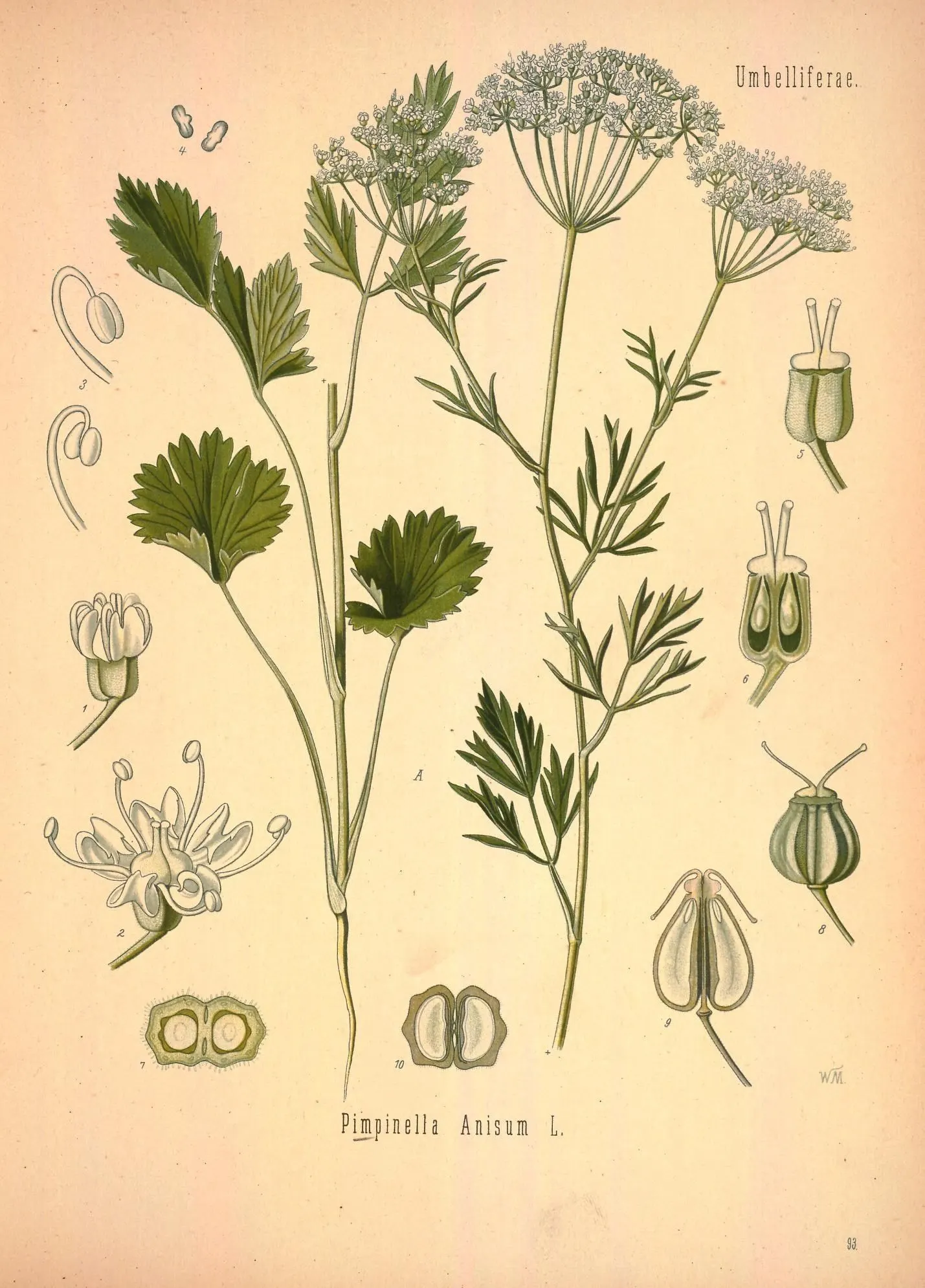
The families are just as far apart. EFSA places Illicium verum in the Schisandraceae;1 older references, including the 1999 PROSEA account, give its family as Illiciaceae.3 Pimpinella anisum belongs to the Apiaceae (Umbelliferae),2 the same family as fennel.8 Neither classification puts the two plants in the same family. What links them is a word, “anise”, and one compound in their oil.
Is anise seed the same as star anise?
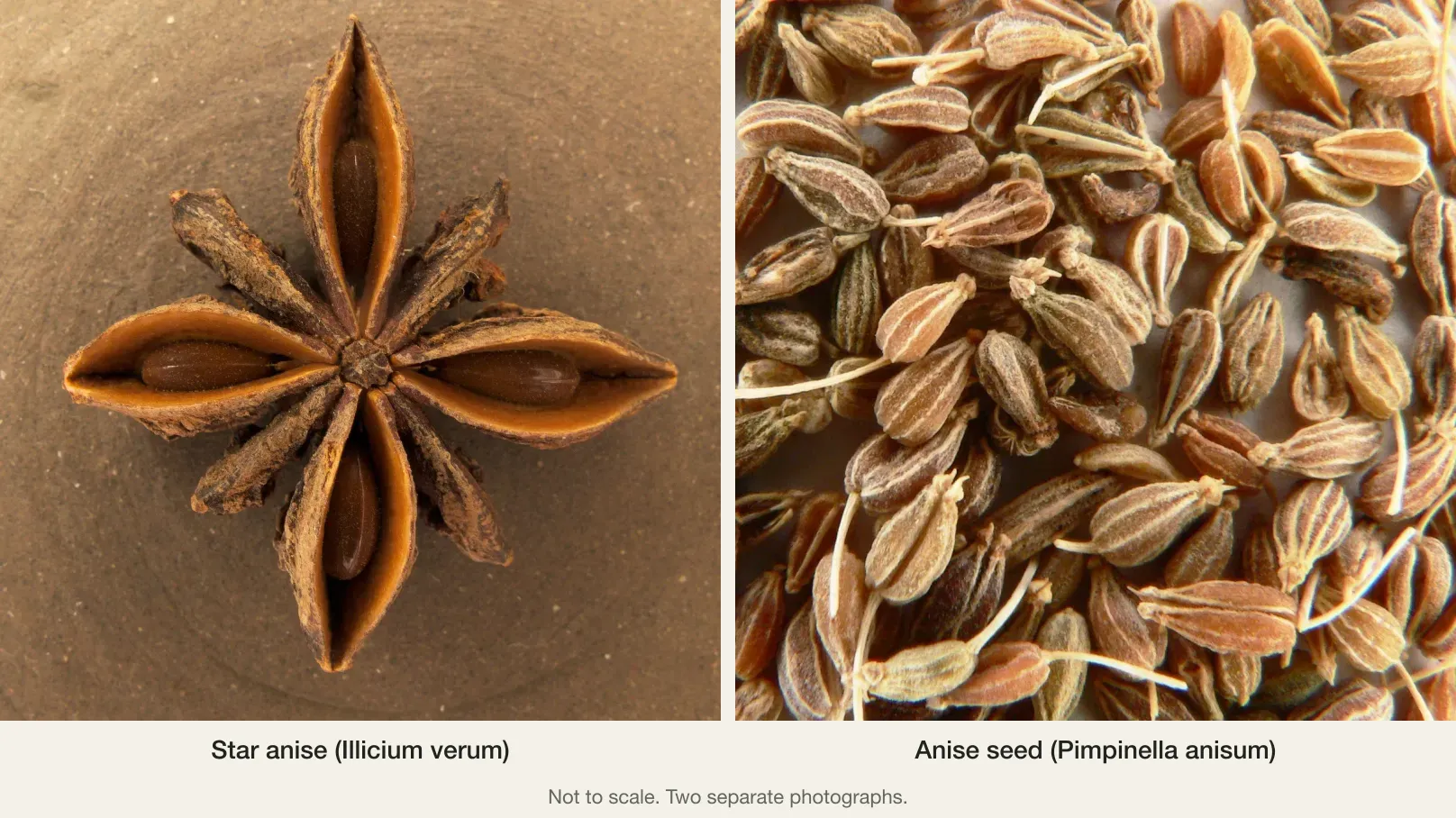
No. Whole anise and whole star anise are different fruits from different plants, and neither is botanically a seed. Anise seed and star anise are both dried fruits, so aniseed vs star anise is a comparison of two fruits that the trade happens to name differently.
A star anise “star” is a composite fruit: usually 8 follicles arranged around a central axis, though the count ranges from 5 to 13, with one seed in each follicle.3 EFSA describes it as a ring of carpels, each containing a single seed.1 So the small seeds inside a star anise pod are Illicium seeds, not anise seeds.
Aniseed is a much smaller fruit: an ovoid schizocarp 3–5 mm long that splits into two halves (mericarps) at maturity.4 EMA describes the herbal substance as the whole fruit, a cremocarp.2

Schizocarp (cremocarp)botany
Why they smell alike: trans-anethole
EFSA explains the name directly: star anise fruit is called “star anise” for its shape and for a sensory profile that “closely resembles that of true anise fruit”.1 The chemistry behind that resemblance is trans-anethole, the main compound in both essential oils.
| Measure | Star anise (Illicium verum) | Anise (Pimpinella anisum) |
|---|---|---|
| Minimum essential oil in the dried fruit | 70 mL/kg (Ph. Eur. 11.0)1 | 20 mL/kg (Ph. Eur. 7th ed.)2 |
| trans-Anethole, pharmacopoeia | at least 86.0% of the oil (Ph. Eur. 11.0)1 | 87–94.0% (Ph. Eur. 7th ed.)2 |
| trans-Anethole, measured | 88.3–88.9% in 4 batches; 89.33–91.75% in 7 batches1 | 75–96.0% across the literature figures compiled by EMA2 |
| Estragole | 3.14–3.68% in 4 batches; 2.67–4.09% in 7 batches1 | 0.5–5.0% (Ph. Eur. 7th ed.)2 |
| A named minor compound | Foeniculin, 0.18–1.34% in 7 batches1 | Pseudoisoeugenyl 2-methylbutyrate, 0.3–2.0% (Ph. Eur. 7th ed.)2 |
Pharmacopoeia figures are as reported by EFSA (2023, citing Ph. Eur. 11.0) and EMA (2013, citing Ph. Eur. 7th edition). Batch figures are one manufacturer’s star anise oil, assessed by EFSA as a feed additive: 4 batches analysed by GC-FID and 7 by GC–MS, as percentage of chromatographic peak area. The oil was distilled from the fruit, with or without leaves, and the seven recent batches all originated in China.1
The overlap is in the main compound: in both standards, trans-anethole makes up well over four-fifths of the oil. The difference is in quantity of oil and in the minor compounds. Ph. Eur. asks for at least 70 mL of oil per kg of star anise fruit and at least 20 mL/kg of aniseed, so the star anise minimum is 3.5 times the anise minimum.1,2 That compares the standards’ floors, not the measured content of any particular lot.
Can I substitute anise for star anise?
Chemically, the two overlap more than the plants do: trans-anethole makes up most of both essential oils (table above). That overlap is why EFSA notes that star anise is “often used as a cheaper substitute for anise fruit” in food, alcoholic beverages and household products.1 It is also why the 1999 PROSEA review recorded that anise oil “is used interchangeably in the United States” with star anise oil, “both under the name ‘anise oil’”.4
So the question of anise or star anise is real, but the answer is not “identical”. The minor compounds differ, as the table shows, and so do the fruits: a star of 5 to 13 follicles against a 3–5 mm fruit that splits in two.3,4 This page compares composition only; it gives no conversion amounts.
One caution on identity: Japanese star anise (Illicium anisatum) is a different, poisonous species that looks almost the same.1,3 See how to tell Japanese star anise from Chinese star anise.
Where each one is grown
Kew’s Plants of the World Online gives the native range of anise as south-eastern Türkiye to central Israel and Cyprus.6 As a crop it travelled far: in 1999 PROSEA listed anise as cultivated in Spain, Italy, the former Soviet Union, Bulgaria, Romania, Turkey, Iran, northern Africa, India, China, Japan, Chile, Argentina and Mexico.4 That list is a 1999 snapshot, not current production data.
Star anise has a far narrower home. Its native range runs from southern and western Guangxi in China to northern Vietnam,5 and PROSEA names China and Vietnam as the major producers and exporters of the fruit and its oil, with China providing the bulk.3 In Vietnam, the largest growing province is Lạng Sơn (Lang Son); read more about where star anise comes from in Vietnam.9,10
What about fennel?
Star anise vs fennel is a simpler question than it looks. Fennel, Foeniculum vulgare, is a perennial of the Apiaceae, the same family as anise,11,8 so it is anise’s relative, not star anise’s. Like aniseed, fennel is sold as dry cremocarps and mericarps.8
Fennel oil also contains anethole, but the pharmacopoeia floors are lower than for anise. Ph. Eur. 10th edition sets at least 80.0% anethole for sweet fennel oil, and at least 60.0% anethole plus at least 15.0% fenchone for bitter fennel oil.8 For anise oil, Ph. Eur. 7th edition allows fenchone at no more than 0.01%.2 Fenchone is the compound that separates fennel oil from anise oil on a lab report.
How they are traded
Customs data does not see the difference at all. In the Harmonized Tariff Schedule of the United States, heading 0909 has one subheading for “Seeds of anise, badian, caraway or fennel; juniper berries”: 0909.61.00 when neither crushed nor ground, 0909.62.00 when crushed or ground.7 “Badian” refers to star anise: PROSEA lists badianier among its French names and Badianifera officinarum as an old synonym.3
The consequence for buyers is practical. US tariff lines cannot separate anise from star anise, or either from caraway and fennel, so trade statistics at this level mix them. On a specification sheet, the Latin name is the clearest identifier. Star anise also has its own ISO specification, ISO 11178:1995.12
What this page does not cover
This page compares two plants by botany, composition and trade classification. It gives no health or dietary advice, and it does not say whether, or how much of, either spice anyone should eat; those are questions for a doctor or pharmacist. It gives no recipes, flavour descriptions or conversion amounts, and no prices: we hold no current price data for either spice. We have not tested, tasted or sourced any sample ourselves.
Frequently asked questions
Can I replace anise with star anise?
By composition, the two overlap: trans-anethole makes up most of both essential oils, and EFSA notes that star anise is “often used as a cheaper substitute for anise fruit”. They are not chemically identical, because the minor compounds differ, and the fruits differ in form. We give no conversion amounts. See Can I substitute anise for star anise?
Does anise seed taste like star anise?
We answer in compounds. The aroma of both comes mainly from the same compound, trans-anethole: Ph. Eur. 11.0 requires at least 86.0% in the essential oil of star anise fruit, and Ph. Eur. 7th edition sets 87–94% for anise oil. The minor compounds differ, so the two are not chemically identical. This page compares composition, not flavour.
Are anise and fennel the same thing?
No. Anise (Pimpinella anisum) and fennel (Foeniculum vulgare) are different species in the same family, Apiaceae. Their oils differ in fenchone: Ph. Eur. 10th edition requires at least 15.0% in bitter fennel oil, while Ph. Eur. 7th edition allows at most 0.01% in anise oil. Star anise is in a different family altogether. See What about fennel?
Image credits
- “Köhler's Medizinal-Pflanzen in naturgetreuen Abbildungen mit kurz erläuterndem Texte (Plate 93) (8232775772)” by Köhler’s Medizinal-Pflanzen (F. E. Köhler, G. Pabst et al.), via the Biodiversity Heritage Library, via Wikimedia Commons, licensed Public domain. Resized; converted to WebP.
- “Star anise vs anise seed (composite)” by Bff; David Monniaux, via Wikimedia Commons, licensed CC BY-SA 4.0. Combined from “Illicium verum20170511 7549” by Bff (CC BY-SA 4.0) and “Aniseed p1160018” by David Monniaux (CC BY-SA 3.0), both on Wikimedia Commons; cropped to square panels and labelled. This combined image is licensed CC BY-SA 4.0.
Sources
- 1
Quotes Ph. Eur. 11.0 for star anise fruit (≥ 70 mL/kg oil, ≥ 86.0% trans-anethole); GC–MS analysis of seven recent batches, all originating from China (Table 3), and GC-FID analysis of four batches against the specification (Table 2); “often used as a cheaper substitute for anise fruit”.
- 2
Quotes Ph. Eur. 7th edition for anise fruit and oil.
- 3
Botany, cultivation, fresh-to-dry ratio, oil composition, China and Vietnam as the main producers. Production figures in this 1999 text are historical and not used as current.
- 4
Plant form, fruit, growing countries “as listed in 1999”.
- 5
Native range “China (S. & W. Guangxi) to N. Vietnam”, read from a search excerpt; the page blocks automated access.
- 6
Native range “SE. Türkiye to Central Israel, Cyprus”; annual. Read from a search excerpt.
- 7
Harmonized Tariff Schedule of the United States, heading 0909
0909.61 / 0909.62 “Seeds of anise, badian, caraway or fennel; juniper berries”. Badian is star anise.
- 8
Assessment report on Foeniculum vulgare Miller, fructus (EMA/HMPC/240553/2016 Rev. 1)
Quotes Ph. Eur. 10th edition for sweet and bitter fennel.
- 9
[Star anise production and trade in Lạng Sơn (Sáng & Nguyệt 2021)]
Four growing provinces; Lạng Sơn area and output 2017–2020 and district shares (from the Lạng Sơn Statistics Office). Does not say whether tonnes are fresh or dried.
- 10
Lang Son grows anise in the organic direction for export
Lạng Sơn as the province with the largest star anise area and output.
- 11
- 12
ISO 11178:1995 Star anise (Illicium verum Hook. f.) — Specification
Reviewed and confirmed in 2024. Numeric limits not read (paid text).